Learning objectives:
- Periodic phenomena have both an amplitude and a frequency.
- The amplitude describes the maximum intensity.
- The frequency describes how often it happens.
A spring
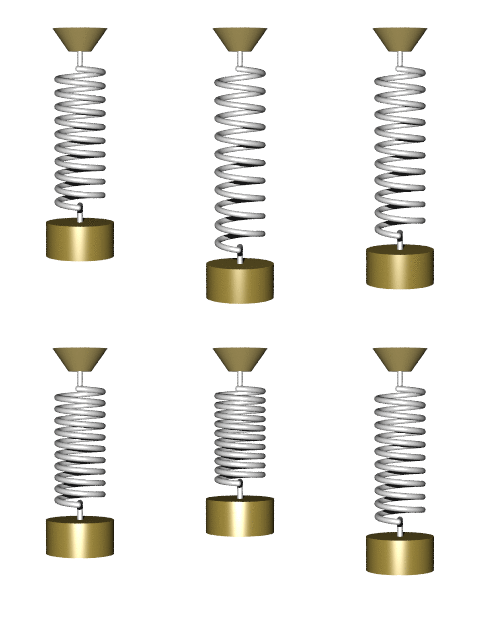
The distance this spring moves is its amplitude.
The number of times it moves up and down over a given time period is its frequency. In this case, the spring moves up and down 13 times a minute.
A pendulum
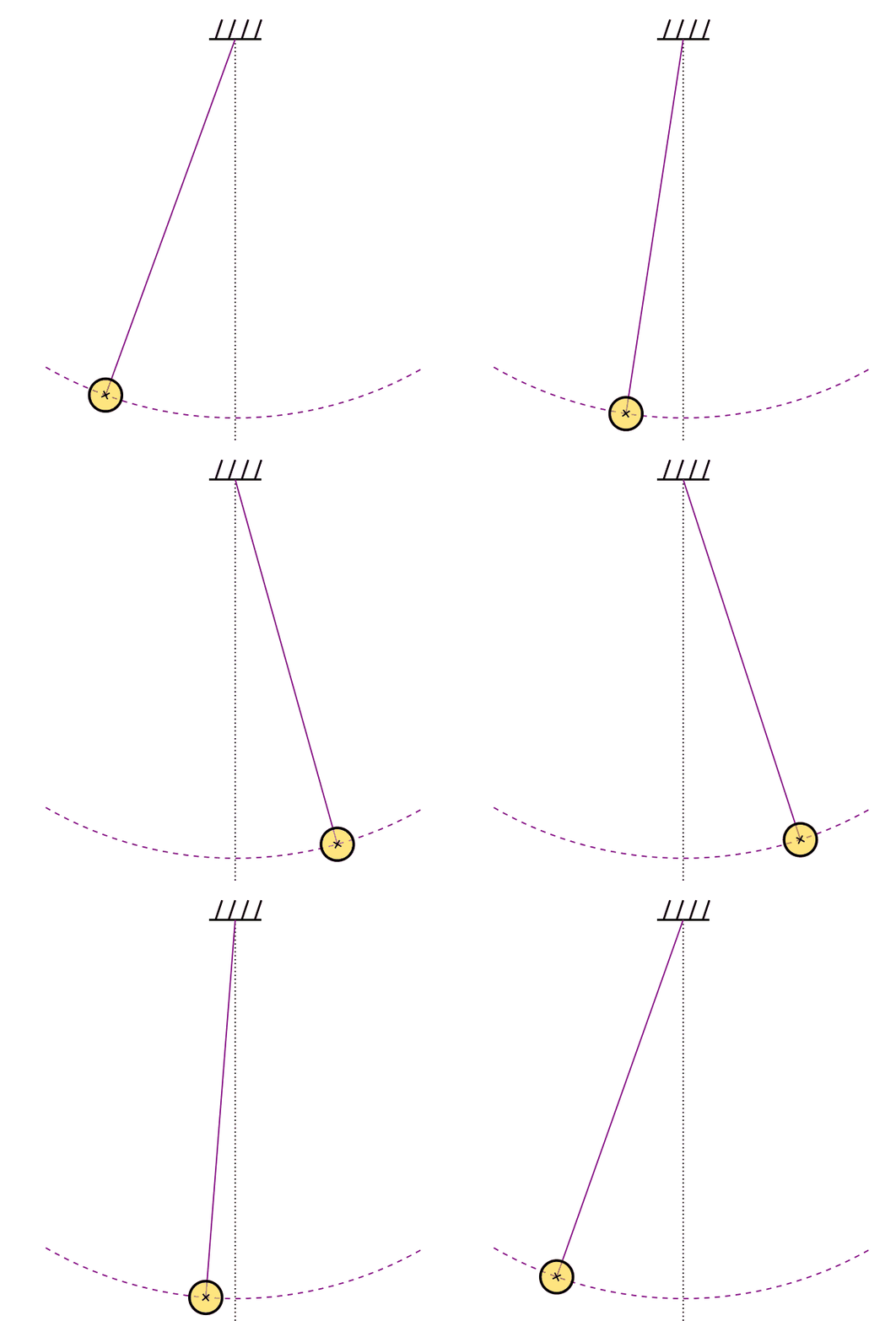
The distance this pendulum moves back and forth is its amplitude.
The number of times that it swings back and forth in a given time is its frequency. This pendulum swings at a frequency of 22 times per minute.
Sine wave
Many phenomena can be described with a sine wave, including the movement of a spring or pendulum, as well as sound and light waves.
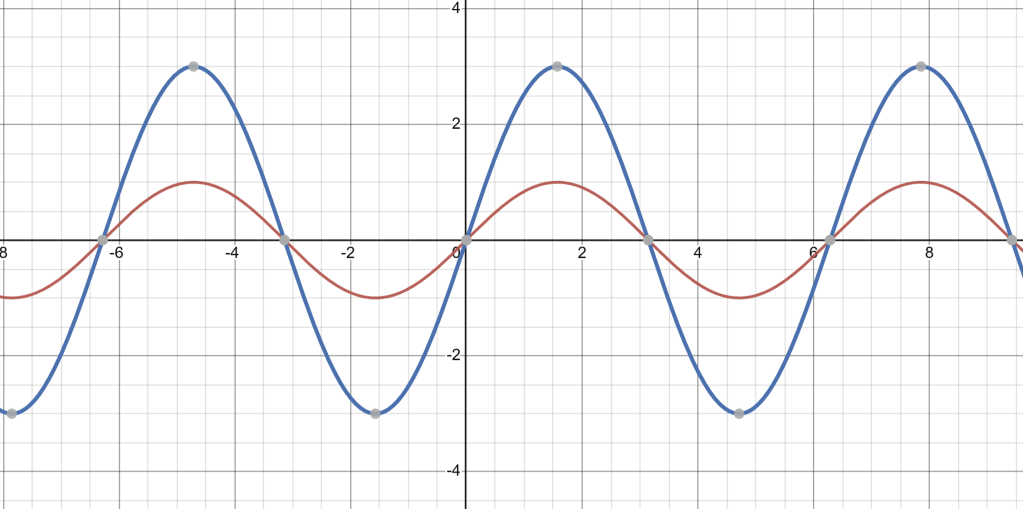
In the image above, the blue wave has a larger amplitude that the red wave. They both have the same frequency.

In the image above, the blue wave has a higher frequency than the red wave. They both have the same amplitude.
Examples of amplitude
- The distance a spring or pendulum moves
- The height a frog jumps
- The loudness of a sound
- The brightness of a light
- The strength of a heart beat
- The voltage of an electrical current
Examples of frequency
- The number of times a spring or pendulum moves up and down in 1 minute
- The number of times a frog jumps in 1 minute
- The pitch of a musical note
- The color of light
- A heart rate
- The frequency of an electrical current
Units of frequency
Frequency is often measured in cycles per second. This unit has a special name, Hertz, which is abbreviated Hz.
Typical examples of frequency
| Phenomenon | Frequency |
| Heart beat | 60 beats per minute (1 Hz) |
| Alternating electrical current | 60 cycles per second (60 Hz) |
| Lowest pitch a person can hear | 20 Hz |
| Highest pitch a person can hear | 20,000 Hz |
| Red light | 1,000,000,000,000 Hz |
| Xrays | 1,000,000,000,000,000,000 Hz |
 CoMo Science
Leave a comment