Learning objectives:
- Understand the difference between longitudinal and transverse waves
- Know that frequency is measured in units called Hertz, which is abbreviated Hz, which represents the number of cycles/second.
- Know that humans can hear frequencies from about 20 Hz to 20,000 Hz.
- Understand that the amplitude of a sound wave determines how loud it is.
- Understand that the frequency of a sound wave determines the pitch.
Longitudinal vs. Transverse Waves
- Waves can be thought of as traveling along a line away from the source of the waves.
- In a transverse wave, the oscillation is at a right angle to the direction the wave is traveling.
- In a longitudinal wave, the oscillation is in line with the direction of the wave.
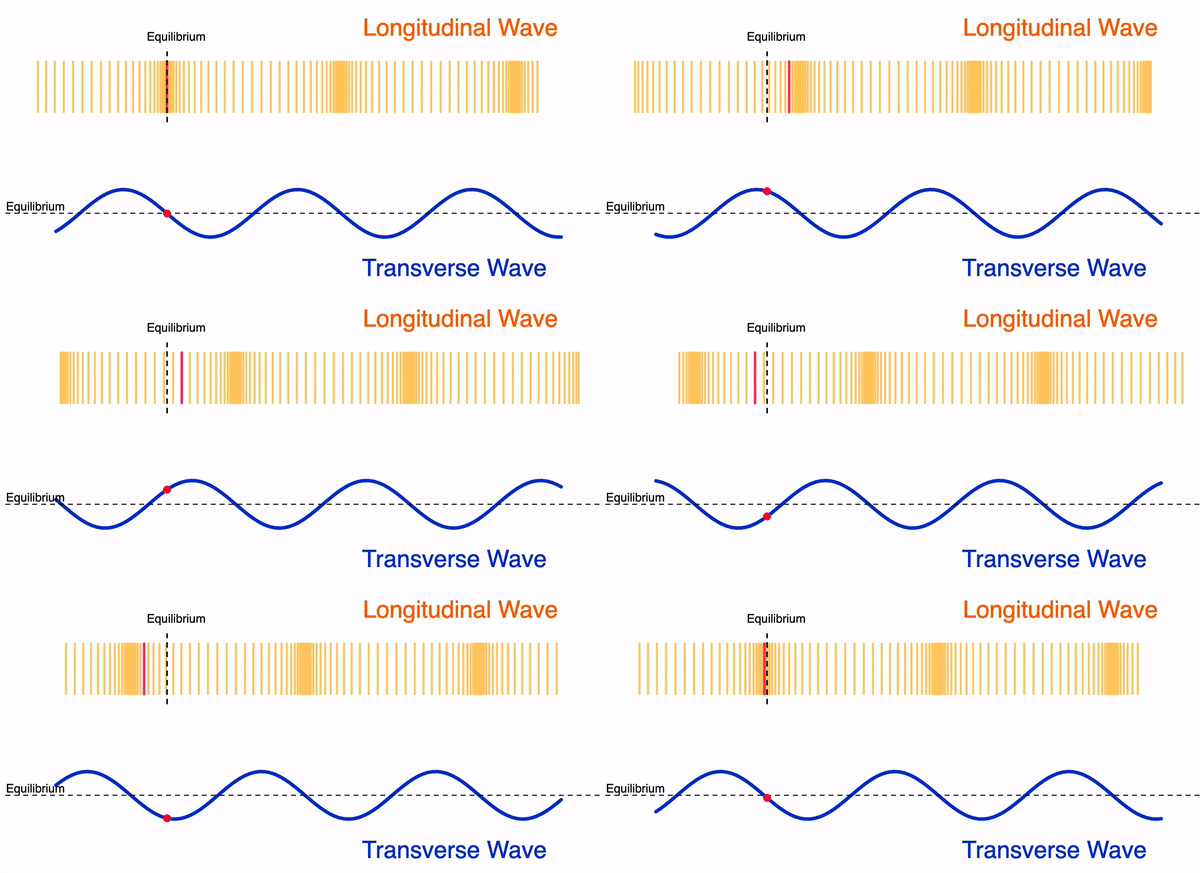
Examples of transverse waves include:
- A vibrating string
- Electromagnetic waves
- Water waves
- Some earthquake waves
Examples of longitudinal waves include:
- Sound waves
- Ripples in a slinky
- Some earthquake waves
A YouTube video of a slinky demonstrating longitudinal and transverse waves.
Resources:
In science club, we played with an app called Phyphox, which allows you to use the sensors on your phone to do multiple experiments.
The experiments that we did include:
- Looking at the wave pattern of our voices when we made different sounds, using “Audio Scope”.
- Looking at the major frequencies of our voices when we made different sounds, using “Audio Spectrum”.
- Looking at the musical pitch that our voices made, using “Audio Autocorrelation”.
 CoMo Science
Leave a comment