- What is a spirograph?
- The equation of a spirograph
- Special situations
- Patterns
- Website
- Desmos
- Other curves
- Coming up…
What is a spirograph?
A spirograph is made by rolling a circle around another circle, like thiis:
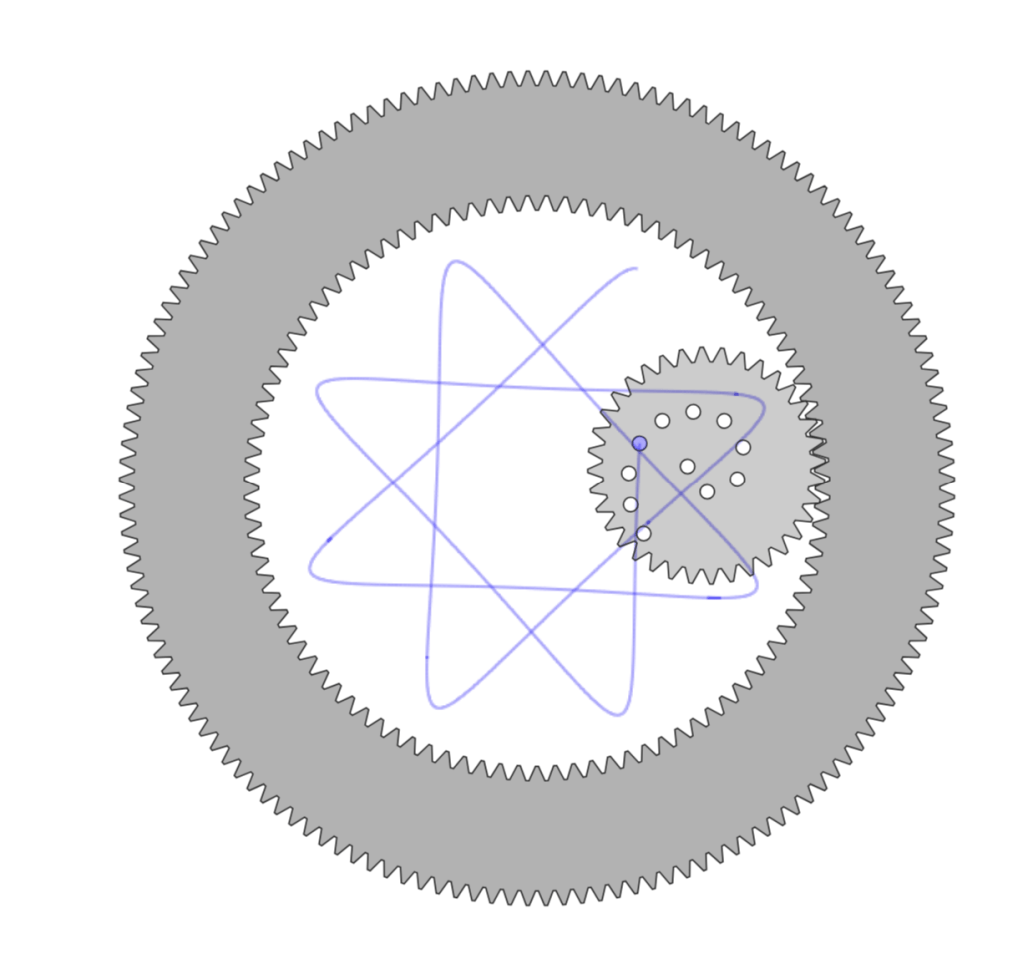
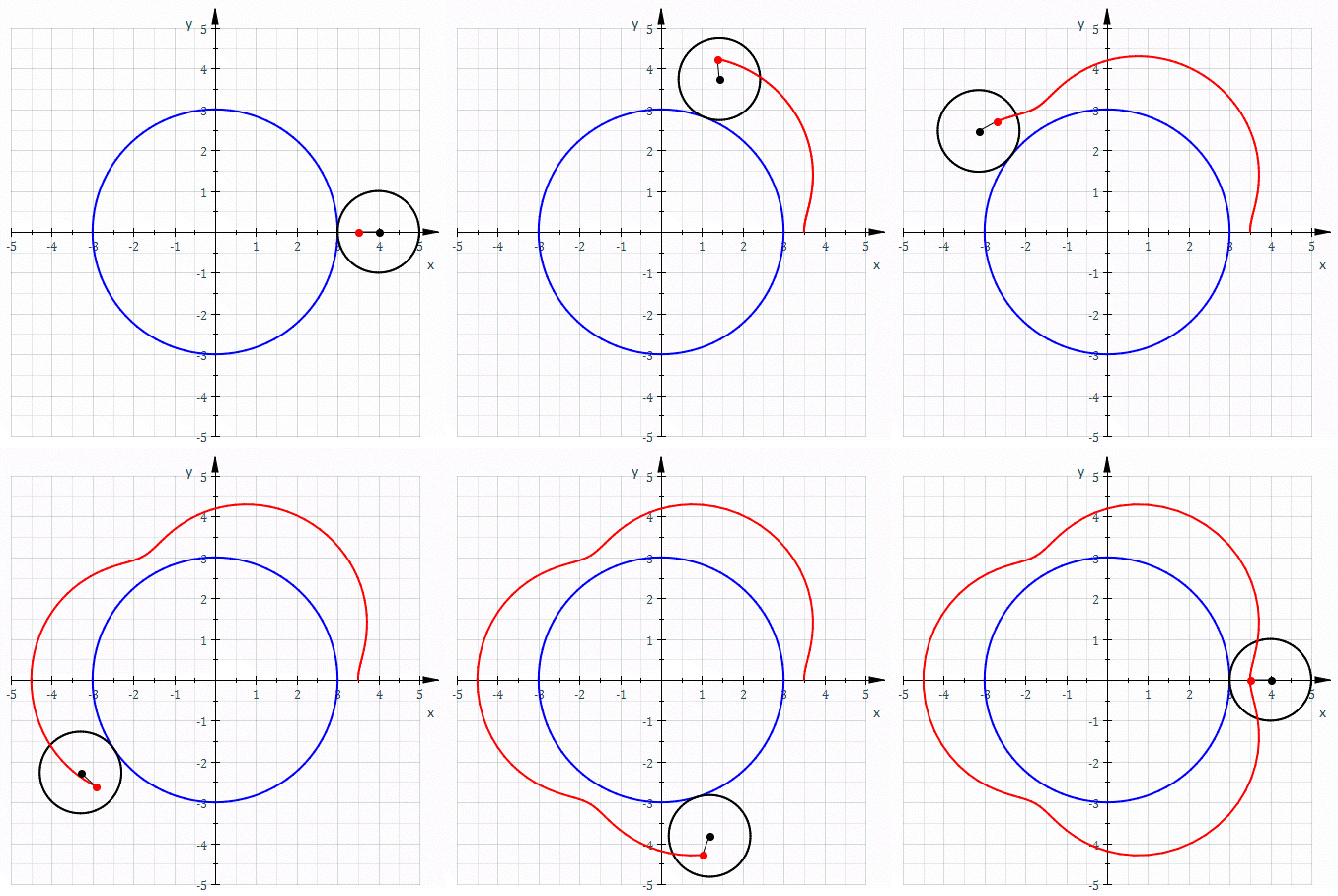
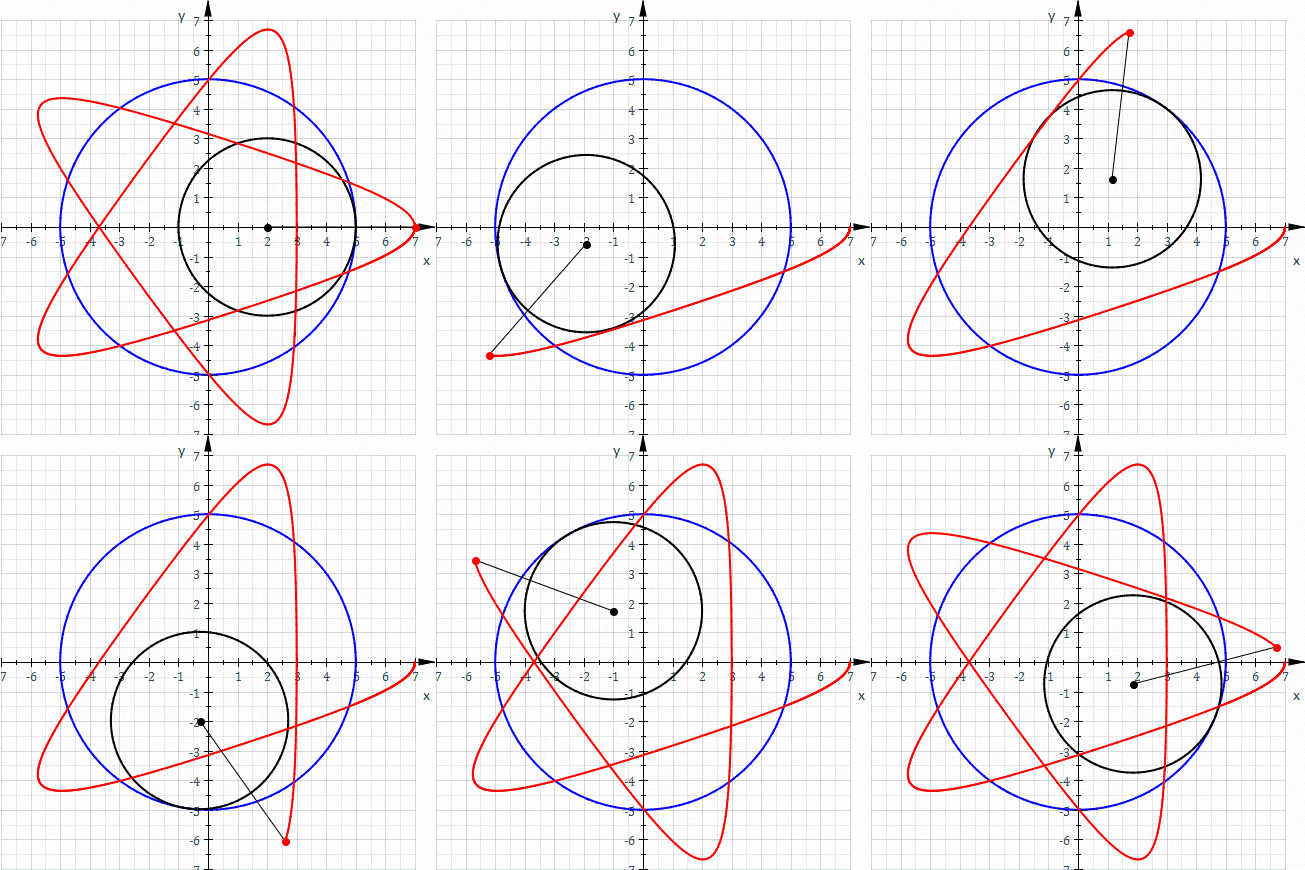
There are two basic types of spirographs: an epitrochoid and a hypotrochoid.
An epitrochoid is made like this:
A hypotrochoid is made like this:
The equation of a spirograph
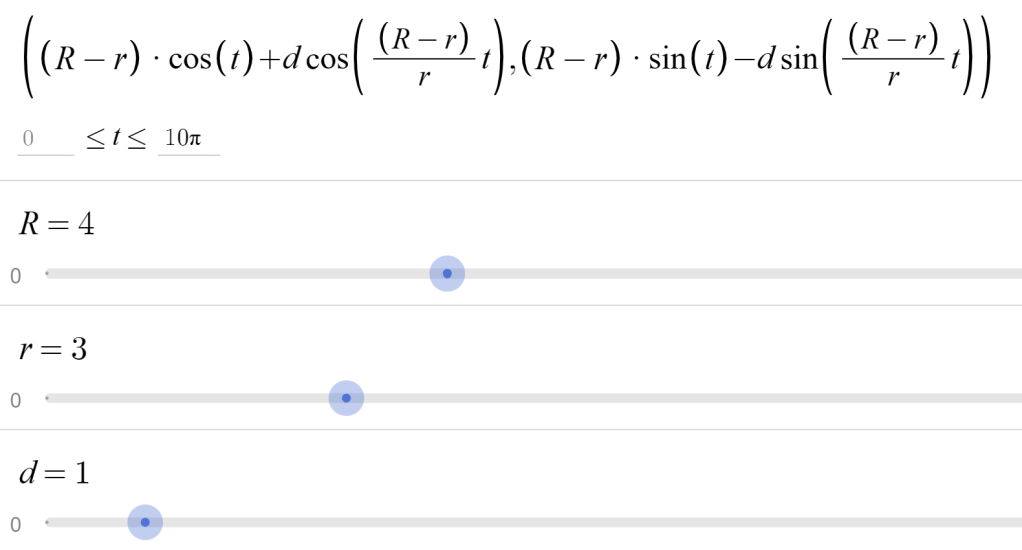
The equation for an epitrochoid is:
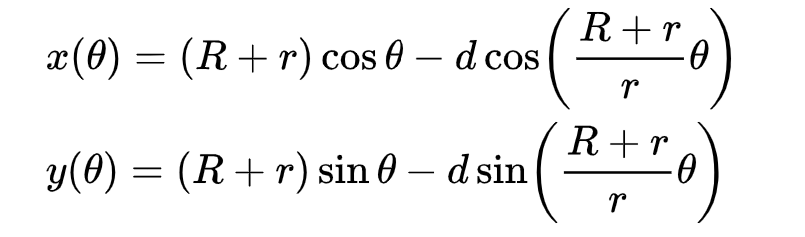
The equation for a hypotrochoid is:

You can see that the two sets of equations are very similar. They will look even more similar if we set a variable, m = R + r, or R – r, respectively.
In each case:
- R represents the radius of the stationary circle
- r represents the radius of the moving circle
- d represents the distance from the center of the moving circle to the pen
In the case of an actual, physical Spirograph, d is always less than r.
Special situations
For a hypotrochoid, when d = r, it becomes a hypocycloid. For an epitrochoid, when d = r, it becomes an epicycloid. In both of these cases, the pen is sitting on the circumference of the circle.
When d = 0, both a hypotrochoid and an epitrochoid become a circle.
When the moving circle is the same diameter as the fixed circle, R = r, they become a special curve called a limacon.
Patterns
The curves are always symmetric about the x-axis, and they are symmetric about the y-axis when m/r is odd.
If m/r is an integer, then there will be m/r – 1 loops.
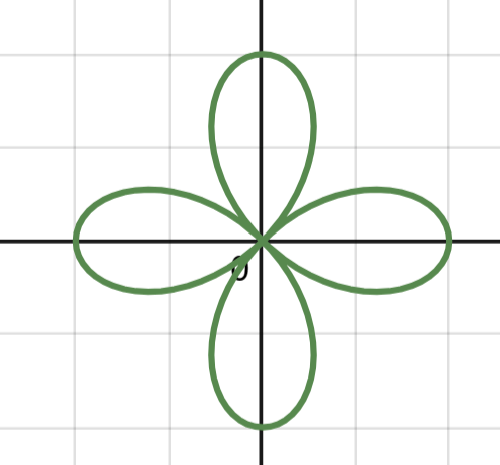
Hypotrochoid with R = 4, r = 3, d = 1

R = 6, r = 2.4, d = 1
Website
The following website lets you draw spirographs:
Inspiral Web (nathanfriend.io)
Desmos
These curves can be drawn on Desmos in the form of (x(t), y(t)), like this:
Other curves
There are dozens of other interesting curves, which can be found at these websites:
- Famous Curves Index – MacTutor History of Mathematics (st-andrews.ac.uk)
- List of Famous Mathematical Curves (matematica.pt)
- two dimensional curves (2dcurves.com)
Coming up…
This is the first of a multi-part series on spirographs. Be sure to read the next post in this series.
 CoMo Science
Leave a comment