Greek and Latin Roots
Here is the list of Greek and Latin roots for this week:
Here is a link to all of the Greek and Latin roots we have discussed.
Here is a link to all of the Greek and Latin roots we have discussed.
Test your memory of the Greek and Latin roots that we have discussed with this quiz.
This is the link to the Wikipedia list of Greek and Latin roots.
ACT Prep
Equations as Shapes
- One of the major advances in mathematics was combining algebra and geometry by graphing functions.
- Every function has its own characteristic shape. The most important to recognize are:
| Function | Shape | Graph |
| y = mx + b | Line | 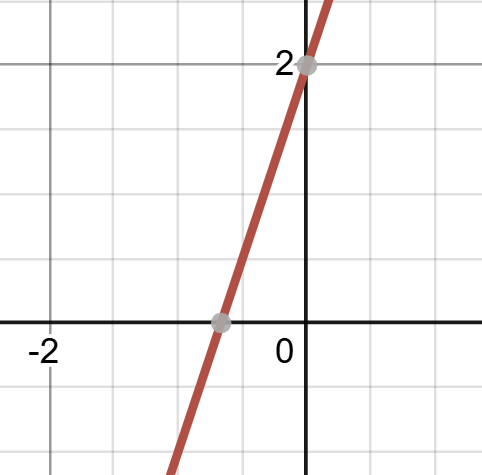 |
| y = x2 | Parabola |  |
| x2 + y2 = r2 | Circle |  |
The Pythagorean Theorem = The Circle Equation
- The Pythagorean theorem states: a2 + b2 = c2.
- The definition of a circle is the collection of all points that are the same distance from a specific point.
- If the circle starts at the origin, then “a” is just “x” and “b” is just “y”. If the center is at (h,k), then “a” is the distance between x and h (“x-h”) and “b” is the distance between y and k (“y – k”). “c” is always just the radius.
Assignments
- List of Greek and Latin roots
- Be sure you know what the example word means.
- Try the Greek and Latin roots Quiz.
- Presentations
- The main point of the presentations is to encourage you to be studying something of interest on your own.
- I encourage you to contact me between sessions if you need help.
Next week we will meet on 8/7/24.
Things We Discussed
Greek and Latin roots
- Arthropod means “jointed legs”. The phylum1 Arthropoda contains insects, spiders, lobsters, crabs, etc. Vertebrates like mammals, despite having joints, are not included.
- Hemoglobin is the protein in blood that carries oxygen.
- Dent-, dont- are two different forms of the same root, both meaning “tooth”.
- Orthodontists straighten teeth
- Many extinct animals contain “dont” or “don” in their names because they are named after their fossilized teeth.
- Ped- can mean “child” as in pediatrics, or “foot” as in pedestrian.
- Osteoporosis means “a condition of having pores in your bones”. (“osis” means “condition”.)

- Osteogenesis imperfecta is a condition caused by a defective collagen gene. Collagen is a structural protein important in developing strong bones. People with osteogenesis imperfecta are prone to having fragile bones that break easily.
Proteins
- Proteins are polymers2 of amino acids3 that are folded into complex shapes.
- A protein may contain only one chain of amino acids, or two or more chains of amino acids that stick together to form a complete protein.
- When two identical chains of amino acids stick together, it is called a dimer (meaning “two parts”).

CT scans
- CT stands for computer-aided tomography. So, sometimes they are called CAT scans.
- CT scans take a lot of pictures using x-rays from multiple angles. This exposes the patient to a lot of ionizing radiation4 which can cause cancer.
- It also provides a very detailed picture of the insides of a patient.

PET scans
- PET stands for positron emission tomography
- Positrons are antimatter particles that have the same mass as an electron but opposite (positive) charge
- When a particle and an antiparticle collide, they destroy each other and turn into gamma rays5.
- To prepare for a PET scan, a patient is injected with a molecule that has a radioactive atom in it.
- The molecule is absorbed by cells and are concentrated in cells that require a lot of energy, such as cancer cells, but also the brain and heart. It is also excreted in the urine and so the kidneys and bladder normally are highlighted.
- When the radioactive atom decays, it emits a positron. The positron soon hits an electron. The positron and electron destroy each other and produce 2 gamma rays. The gamma rays travel in opposite directions.
- The PET scanner detects the gamma rays and can calculate where they came from in the body by time difference of when they are detected.

Monostable 555 Timer Circuit
The 555 Timer Integrated Circuit is a microchip that is commonly used for many different circuits.
This is the physical chip that one would use to make the circuit. The black part is a plastic coating for a very small and thin circuit inside. The metal legs are made for connections to the outside circuit. The legs are much bigger than the wires inside the plastic.
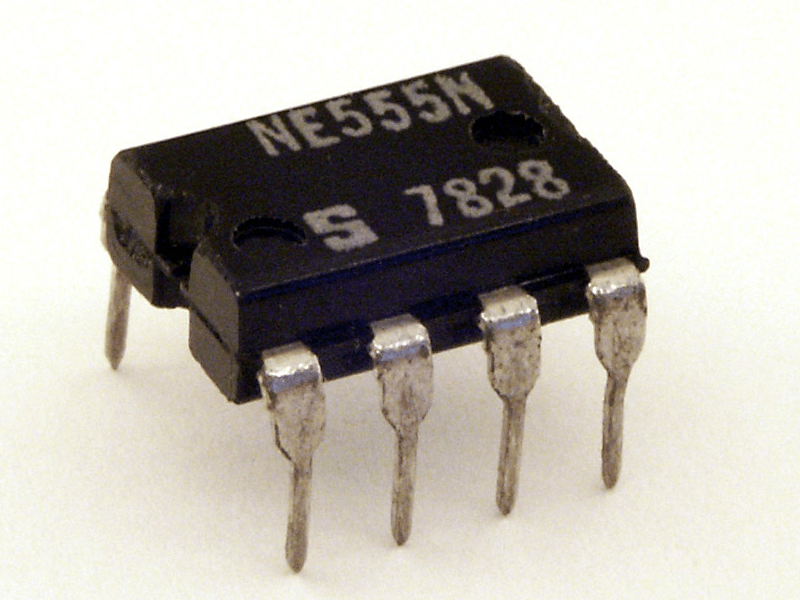
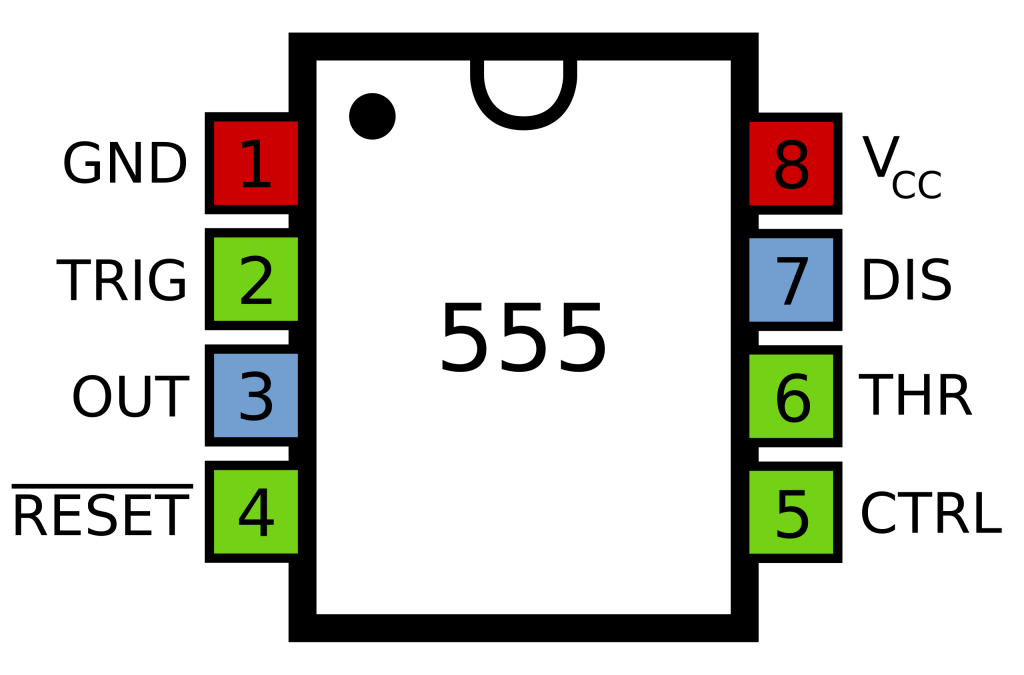
Each leg has a specific function. Because the chip is symmetric on the outside, there is a mark next to pin 1 to make sure you orient it the right way. The mark might be a small circle (the black dot) or a notch (like on the chip above).
A monostable circuit turns power on to another part of the circuit for a specific length of time, independent of how long the trigger signal is. For instance, when you push the button on a garage door opener, the light will stay on for several minutes before automatically turning itself off.
The circuit diagram that one uses to hook up the circuit correctly often has the pins in a different location than the way they are arranged on the actual chip.

Although the circuit may look complicated, the trick is to systematically focus on one pin at a time, working your way from pin 1 to pin 8, making sure that each pin is connected properly.
For instance, pin 1 only has to be connected to the negative terminal, pin 4 only has to be connected to the positive terminal pin 6 only has to be connected to pin 7.
Breaking Down Complex Concepts
One of the main approaches of science is to understand a complex concept by understanding its individual parts. This is called “reductionism.”
Even when a concept is beyond you, it is better to seek to understand what you can, rather than dismiss the whole thing.
For instance, a complex chemical structure may not be understandable, but you may be able to at least see what elements it contains or recognize some functional groups within it.

A second example is an electronic circuit which may contain a bewildering arrangement of wires and components, but on closer inspection, may be seen to contain parts that you can comprehend.
This is a great video that shows how a complicated circuit is actually built little-by-little from simple circuits.
 CoMo Science
Leave a comment