There are several different ways to represent the structure of a molecule.
Chemical formula
A chemical formula gives the types and number of atoms in the molecule. Sometimes to better indicate the structure of the molecule, the order of the atoms is modified, such as with acetic acid below.
| water | H2O |
| methane | CH4 |
| glucose | C6H12O6 |
| acetic acid | C2H4O2 or CH3COOH |
Skeletal model
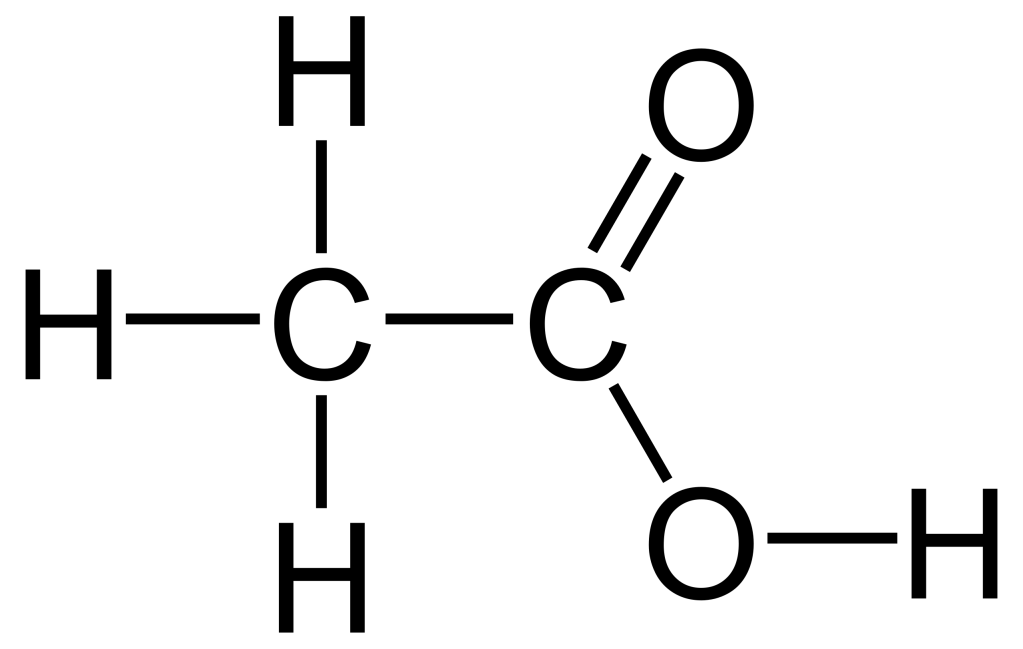
Because carbon and hydrogen are so common in organic molecules, their presence is often implied without explicitly writing a C or H. Instead, a carbon is represented by the junction of two line segments or the end of a line segment that is not attached to a different atom. Because carbon almost always has 4 bonds, a hydrogen is implied any time a carbon is shown with less than 4 bonds.

Skeletal models are the most common representation and there are many additional features of them that are used to represent benzene rings, hydrogen bonds, unspecified functional groups, and the 3-dimensional structure of the molecule. More information can be found here: https://en.wikipedia.org/wiki/Skeletal_formula
Ball-and-stick model
A ball-and-stick model shows the 3-dimensional arrangement of the atoms in a molecule. Although individual atoms do not have a color, there is a standard color scheme used to represent several atoms.
| atom | color |
| carbon | black |
| hydrogen | white |
| nitrogen | blue |
| oxygen | red |
| chlorine | green |
This is a ball-and-stick model of acetic acid.

Space-filling model
A space-filling model shows the overlap of the electrons around the atoms in a molecule.

Ribbon (or Richardson) diagrams
Protein molecules are too large to draw every atom. They are often represented by ribbon diagrams which illustrate the main structures of the protein, especially an alpha helix and a beta pleated sheet.

Surface structure
Proteins are too large to show each individual atom. Sometimes, the overall shape of the molecule is represented with a surface structure diagram. These diagrams are not intended to represent each individual atom. In addition, the colors typically do not represent the different types of atoms the way that a ball-and-stick model or a space-filling model does. Instead, the colors represent different subunits that come together to form the protein.

 CoMo Science
Leave a comment