Upcoming Events and Goals
There is a health science research day on November 15 at the medical school. This will have a lot of students presenting their research. This is done in a room full of students standing next to posters displaying their research and answering questions about their research. There will be a wide variety of research, some of which is fairly straightforward to understand and some of which is overwhelmingly difficult. Fortunately, we are free to choose who we want to interact with. To give you an idea of the range of topics, here is a list of the posters from last year.
I would like you to consider being there from 8 to 11 am when the undergraduates will be presenting their research. You don’t have to be there the whole time. You will need to talk to your parents about getting out of school and getting there and getting picked up. I’ll be there at 8 to meet you and help you make connections, talk to people and understand their research.
In the meantime, I want to help prepare you to be able to interpret their posters so that you can understand the discussion and ask good questions.
Topics we have covered related to this:
- the organization of a research paper (which is also reflected in a poster)
- root words that are used frequently in research
- structural diagrams of organic molecules
- scientific notation
- error bars
- cell membrane receptors
- medical imaging
- antibodies
- microscopy pictures
- genetics
- statistics
- p values
- standard deviation
- confidence intervals
Topics we will need to cover in the next few weeks:
- gel electrophoresis
- polymerase chain reaction (PCR)
- model organisms
- reading graphs and charts
- bar charts
- pie charts
- line graphs
- histograms
- semi-log graphs
- log graphs
- Kaplan-Meier plots
- units
Greek and Latin Roots
Here is the list of Greek and Latin roots for this week:
Here is a link to all of the Greek and Latin roots we have discussed.
Test your memory of the Greek and Latin roots that we have discussed with this quiz.
This is the link to the Wikipedia list of Greek and Latin roots.
Assignments
- Fill out the list of Greek and Latin roots.
- Write in the meaning of each root
- Give at least one example of each, be prepared to give its actual definition and the way that it is related to the root word
- Example: If I gave you the root “onym”, you could give the word “synonym” which has the definition of two words with the same meaning. The two roots in the word “syn” and “onym” mean “same name”, indicating two words that name the same thing.
- Fill out the blank space at the bottom with your own root that you have discovered. This will likely come from some of the example words that you have already written. Give a different example than what you have used.
- Example: syn- means “same”, example word “synchronous”
- Presentation
- Research your topic of choice and be prepared to give a 5-minute presentation on the topic, geared toward people your age level.
- Include the background information needed for someone who does not know the topic as well as you.
- Be prepared to talk about how you found this information.
Next week we will meet on 10/31/24.
Things We Discussed
Greek and Latin roots
heter – different
heterotopic – in a different place
A kidney transplant is a heterotopic transplant meaning the kidney is placed in a different location than the existing kidneys. (Liver and heart transplants are orthotopic transplants, in which the diseased organ is removed and the transplanted organ is placed in the same location.)

DNA, RNA, Proteins
The concepts of DNA, RNA and proteins are essential for understanding modern biological research. However, it is easy to get confused by the details. The level of detail that is needed depends on the type of research that is being discussed.
Here are the essential facts to know about DNA, RNA and proteins for much of biological research:
DNA:
- DNA is a polymer1 made of two strands that are linked together by nitrogenous bases that include adenosine, guanine, cytosine, and thymine.
- DNA is a long-lasting molecule that encodes the genetic information in an organism.
- DNA encodes the information needed to make proteins and no other molecules.
- The sequence of DNA that codes for a specific protein is known as a gene.
- DNA is not used to make proteins directly. Instead, it is used to make RNA in a process called transcription2. RNA is then used to make proteins in a process called translation.
RNA
- RNA is a single stranded polymer that is made of adenosine, guanine, cytosine and uracil.
- RNA typically doesn’t last very long. However, multiple copies of RNA can exist in a cell and each copy can be used many times to make a protein.
- There are two main types of RNA: mRNA which codes for proteins and tRNA which is used to decode the mRNA and connect the amino acids together to make the protein.
Proteins
- Proteins are polymers made of amino acids. There are 20 amino acids that are used in proteins.
- Proteins have multiple levels of structure and must be folded correctly in order to function properly.
- The main two classes of proteins are enzymes and structural proteins, although there are others, such as antibodies.
- Enzymes catalyze chemical reactions in cells.
- Structural proteins form the structure of the cell and cause movement within the cell.
Isolating DNA
One method of isolating DNA is to use gel electrophoresis and then cut the DNA directly out of the gel.
Genetic engineering
Restriction enzymes are enzymes produced by bacteria to protect the bacteria against viruses. Many restriction enzymes have been discovered. These enzymes break the DNA in specific locations. The enzyme can be used to isolate the desired gene.
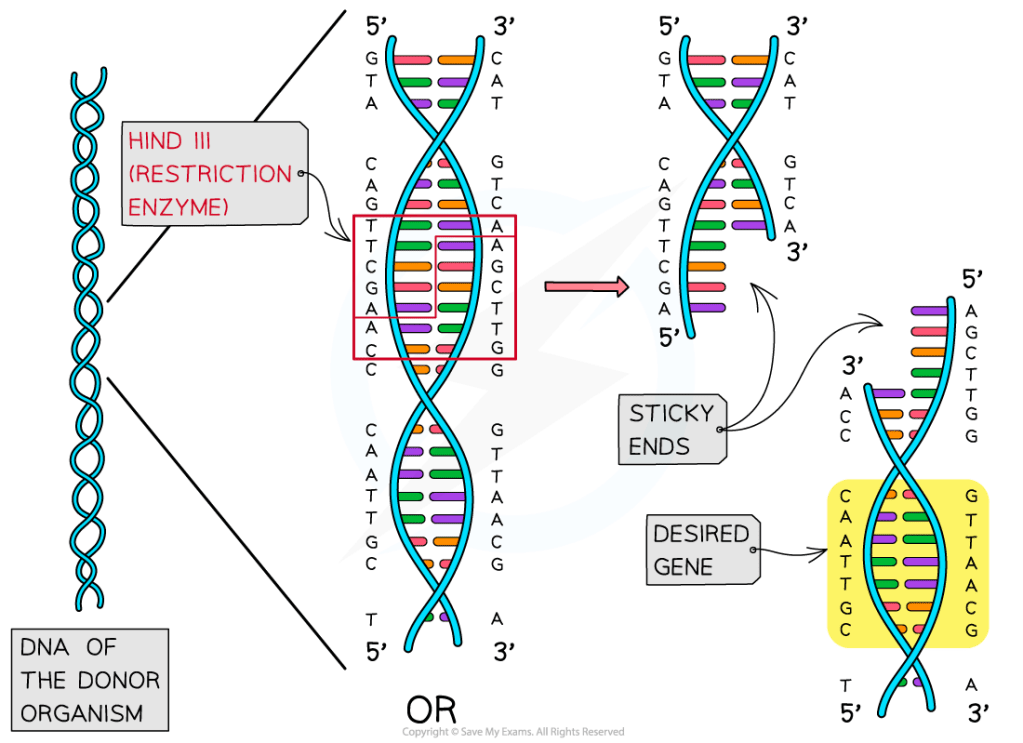

Recombinant Insulin
Chimera

Originally, a chimera was a monster in Greek mythology that was a mixture of several animals. In modern science, the word “chimera” has come to mean something that has parts from at least two different species.
Several uses of the word include:
- chimeric antibodies
- chimeric proteins
- chimeric mice
Chimeric antibodies
Infliximab is a monoclonal antibody that is used to treat rheumatoid arthritis. It is a combination of a mouse antibody and a human antibody. The antibody was originally developed in a mouse, however, it was modified so that the human immune system would not recognize it as a foreign protein.

Chimeric proteins
An important new cancer treatment is called chimeric antigen receptor (CAR) T-cell therapy. A chimeric antigen receptor is a combination of two different proteins. The therapy involves removing T cells from the patient and genetically modifying them to produce a chimeric antigen receptor on its surface. These cells then bind to antigens on the tumor and attack the tumor.
Chimeric animals
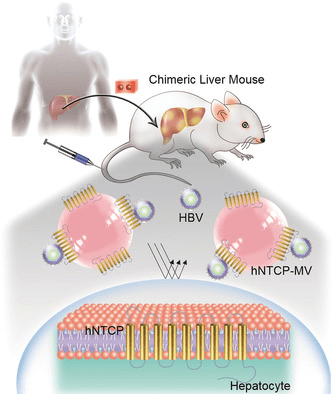
One example of a chimeric animal would be a mouse that is given human liver cells in order to be able to study the hepatitis B virus, which infects human liver cells but not mouse liver cells.
Statistics
In general, analysis of a set of data produces a single number (such as an average) as a final result. However, this number can only be interpreted as an approximation of the true value. An important part of analyzing data is estimating how close the calculated result is to the true value.
There are several ways that are used to calculate how close a result is to the true value. These include:
- the p value, often written as “the relative risk was 1.3 (p < 0.05)”
- the standard deviation, often written as “Mean height = 136.4 cm (SD = 15.1)” or “Mean height = 136.4 cm ± 15.1 cm”
- the confidence interval, often written as: “the result was 4.9 [95% CI, 1.3 to 8.7]”
Understanding the proper interpretation of the each of these is difficult. The important thing is to recognize that these are used to indicate how close the result is likely to be to the true value. A p value > 0.05 and a confidence interval that contains 0 (for a difference3) or 1 (for a ratio) is not considered statistically significant.
Footnotes
- Polymers (Basic science review) ↩︎
- Transcription, translation, & the genetic code (Basic science review) ↩︎
- A difference is the result of a subtraction problem. A ratio is the result of a division problem. ↩︎
 CoMo Science
Leave a comment