- Greek and Latin Roots
- Important Points We Discussed
- Details of Things We Discussed
- Things To Do
- Footnotes
Greek and Latin Roots
Here is the list of Greek and Latin roots for this week:
Here is a link to all of the Greek and Latin roots we have discussed.
Test your memory of the Greek and Latin roots that we have discussed with this quiz.
This is the link to the Wikipedia list of Greek and Latin roots.
Important Points We Discussed
Arduino
- There are only three basic things that an Arduino can do:
- Send out a digital signal
- Read in a digital signal
- Read in an analog signal
- The same Arduino program can control different electronic components to produce different results.
- When you are learning to program, it is often helpful to write just enough code to demonstrate that you can accomplish a certain task without actually putting in the effort to complete it.
Alcoholic Fermentation
- Alcoholic fermentation and lactic acid fermentation are two types of anaerobic cellular respiration.
- Typically, animals breathe in oxygen to use in aerobic cellular respiration.
- Animals use lactic acid fermentation whenever they use more energy than they can make with aerobic cellular respiration (like with sprinting).
- Yeast use alcoholic fermentation, which is why they are used to make beer.
Collecting Gas Over Water
- Collecting a gas over water is a standard method of both collecting the gas and measuring the amount of gas produced.
Experimental Design
- One of the main challenges of a researcher is to develop a good experimental design.
- One important consideration is how to automate the collection of data which can increase the amount of data collected for each experiment and allows for multiple experiments to be run as the same time.
Quadratic Equations
- A quadratic equation has the form y = ax2 + bx + c.
- The plot of a quadratic equation is a parabola.
- The roots of an equation are the values of x where the curve crosses the x-axis.
Continuous Probability Distributions
- Probabilities can be discrete or continuous.
- The probability of a specific number from a continuous distribution is zero.
Details of Things We Discussed
Arduino
- There are only three basic things that an Arduino can do:
- output a digital signal of either on or off.
- input a digital signal, which is interpreted as either HIGH or LOW.
- input an analog signal, which yields a number between 0 and 4096.
- The same Arduino program can control different electronic components to produce different results.
- When you are learning to program, it is often helpful to write just enough code to demonstrate that you can accomplish a certain task without actually putting in the effort to complete it.
Here is a series of posts describing how to convert the blink program into a program that will receive any message from the computer and blink it out.
- Arduino: Understanding the Structure of C
- Arduino: Understanding Blink
- Arduino: Modifying Blink
- Arduino: Functions & Variables
- Arduino: Strings & Serial
- Arduino: If & For
- Arduino: Putting It Together
Yeast
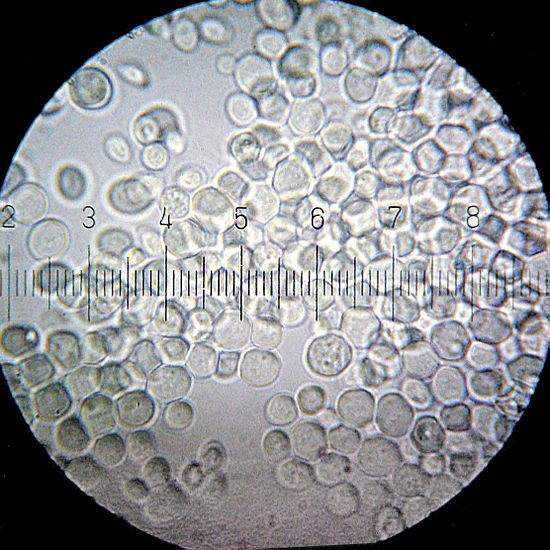
The type of yeast we used was “active dry yeast”. According to Wikipedia, active dry yeast consists of coarse oblong granules of yeast, with live yeast cells encapsulated in a thick jacket of dry, dead cells with some growth medium. The growth medium provides extra material that the yeast needs to grow and replicate. For example, the sucrose (table sugar) that was used to feed the yeast does not have any phosphorus in it. Since phosphorus is essential for the yeast, the yeast would soon die without the phosphorus being supplied by the growth medium.
These pictures compare the size of a granule of active dry yeast, which we could see coming from the package, with the size of the individual yeast cells. Notice the measuring scales on each photo.

Alcoholic Fermentation
Photosynthesis involves converting carbon dioxide and water into glucose using sunlight. This is why plants take in carbon dioxide and put out oxygen.
CO2 + H2O + light (a form of energy) -> C6H12O6 + O2
Aerobic cellular respiration is the process glucose and oxygen into carbon dioxide, water and energy. The equation can be thought of as the reverse of photosynthesis. This is why animals breathe in oxygen and breathe out carbon dioxide.
C6H12O6 + O2 -> CO2 + H2O + energy
Alcoholic fermentation converts glucose into energy without using oxygen.
Collecting Gas Over Water
Conic sections & Planetary motion
A conic section is the cross-section of a cone cut by a plane.
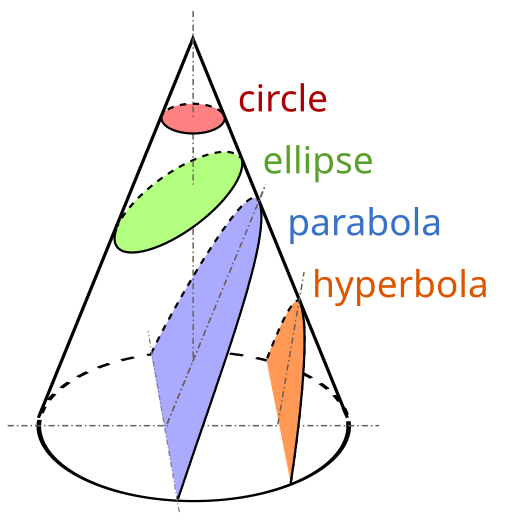
In the case of two objects (the sun and a planet) in a gravitational field, all of the paths of the planet are conic sections.
The shape of the orbit of a planet depends on its speed. Because of the law of conservation of energy, as the planet gets further from the sun, its potential energy increases and the kinetic energy (and its speed) decreases.
The escape velocity is the speed at which the total energy of the planet is equal to what its potential energy would be if the planet were infinitely far from the sun. When a planet is moving at exactly its escape velocity, it follows a parabola. If it is slower than the escape velocity, the orbit is an ellipse. If it is moving faster than its escape velocity, it follows a hyperbola.
The shape of the conic section is measured by its eccentricity.
- The eccentricity of a circle is 0.
- The eccentricity of an ellipse which is not a circle is between 0 and 1.
- The eccentricity of a parabola is 1.
- The eccentricity of a hyperbola is greater than 1.
Continuous Probability Distributions
- Because there are an infinite number of possible values, the probability of any specific value of a continuous random variable is zero.
- This can be seen in the orbits of planets.
- The eccentricity of a planet’s orbit will never be exactly 0, so no planet will ever have a perfectly circular orbit.
- The eccentricity of a planet’s orbit will never be exactly 1, so no planet will ever follow a perfect parabola. (Another way to say this is that no planet’s velocity will ever be exactly its escape velocity.)
- Therefore, all planets will follow either an elliptical orbit or a hyperbolic orbit.1
Things To Do
- Fill out the list of Greek and Latin roots.
- Write in the meaning of each root
- Give at least one example of each, be prepared to give its actual definition and the way that it is related to the root word
- Example: If I gave you the root “onym”, you could give the word “synonym” which has the definition of two words with the same meaning. The two roots in the word “syn” and “onym” mean “same name”, indicating two words that name the same thing.
- Fill out the blank space at the bottom with your own root that you have discovered. This will likely come from some of the example words that you have already written. Give a different example than what you have used.
- Example: syn- means “same”, example word “synchronous”
- Presentation
- Research your topic of choice and be prepared to give a 5-minute presentation on the topic, geared toward people your age level.
- Include the background information needed for someone who does not know the topic as well as you.
- Be prepared to talk about how you found this information.
Next time we will meet on 1/23/25.
Footnotes
- This is how astronomers determine whether an asteroid is bound to the sun (following an elliptic orbit) or has an interstellar origin (following a hyperbolic path). Only two objects have been discovered that are thought to have entered the solar system from interstellar space. From Wikipedia: “The first interstellar object which was discovered traveling through the Solar System was 1I/ʻOumuamua in 2017. The second was 2I/Borisov in 2019. They both possess significant hyperbolic excess velocity, indicating they did not originate in the Solar System.” ↩︎
 CoMo Science
Leave a comment