What are Biogeochemical Cycles?
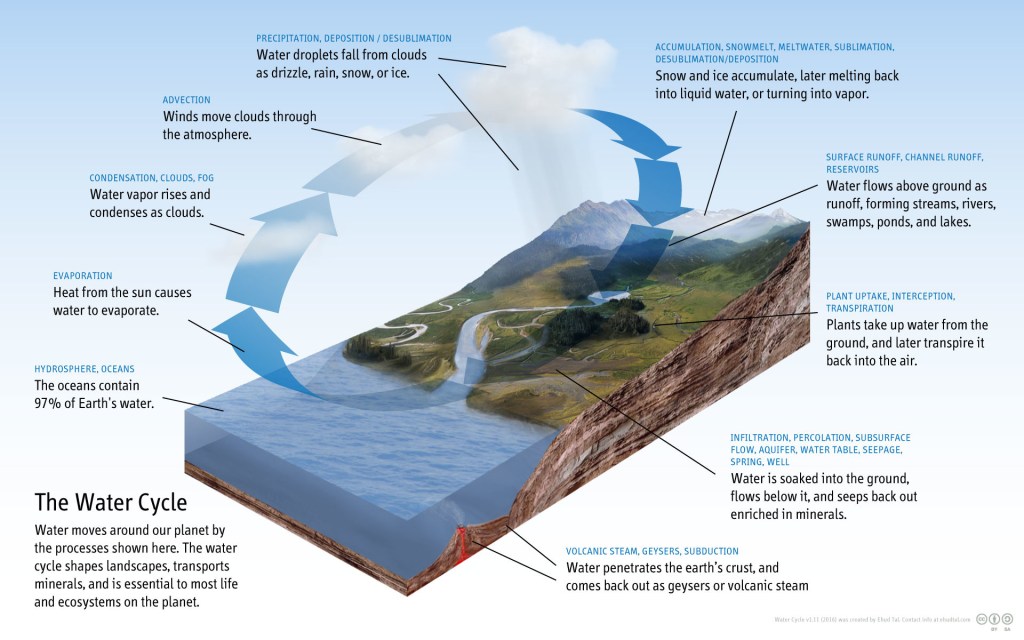
Biogeochemical cycles are the ways that important atoms and molecules are used and regenerated in our environment. The major cycles include the water cycle, the carbon cycle, the nitrogen cycle and the oxygen cycle. The details of these cycles are a synthesis of concepts in biology, chemistry, meteorology and ecology.
The Fundamental Skills:
- Understand the conservation of matter.
- Recognize that because of the conservation of matter, atoms are not (easily) created or destroyed and therefore they have to be recycled.
- Understand that there are natural processes that have recycled the same atoms and molecules since the world began.
- Recognize that human processes can disrupt these cycles in ways that can have serious consequences for humanity.
Words to Use:
- Conservation
- Evaporation
- Atoms
- Molecules
- Combustion
- Oxidation
- Closed and open systems
- Reservoir
Prerequisite Skills:
None
Ways to Practice:
- Discuss where our water out of the faucet comes from
- Discuss how plants produce the oxygen that animals breathe
- Discuss how atoms persist throughout chemical reactions
- Discuss processes that do not recycle: radioactive decay, oxygen on planets without life
- Compare how food is regenerated in a closed system like the Earth compared to an open system like your house
- Discuss rain and evaporation
- Discuss how evaporation purifies water
- Discuss how water can be split into hydrogen and oxygen but this does not happen frequently because it takes a lot of energy
- Discuss how the water cycle works differently in the desert than it does in the rain forest or over the ocean
- Discuss how the total amount of water on Earth is relatively constant, but that water cycle can be distorted by climatic changes that lead to droughts, ice ages, etc.
- Discuss how oxygen combines with molecules quickly when they burn and slowly when the oxygen combines with molecules in our bodies. Both processes produce carbon dioxide.
- Discuss what would happen if trees never rotted
- Discuss the composition of the atmosphere
- Discuss the need to fertilize plants because nitrogen gas, although plentiful, is not usable by plants
- Compare the equation describing photosynthesis with the equation describing the metabolism of sugar
- Discuss what would happen if each of the cycles were stopped
- Discuss ways that each cycle could be disrupted
- Discuss how overfertilization leads to dead zones in bodies of water
Advanced Skills:
- Transpiration is the absorption of water by plant roots, the transportation of the water up the stems and evaporation of the water through the leaves. This can speed up the water cycle. This is the only part of the water cycle that might not be familiar by the time the water cycle is introduced.
- The nitrogen cycle includes several relatively specialized bits of information.
- There are a great many cycles that are not typically discussed. Focusing on the fundamental skills listed above helps with the understanding that this must be the case. A list of these cycles can be found here.
- The oxygen cycle has a great deal of overlap with the carbon cycle, but also includes processes that are geological, rather than biological, in nature.
- The development of dead zones is a multi-step process that requires a logical understanding of the consequences of each step in this process.
Non-transferable Skills:
The concept of biogeochemical cycles synthesizes a multitude of concepts earlier and the skills developed in understanding of these cycles are generally transferable throughout many scientific fields. However, it is possible to get lots in the details.
- Details of nitrification
- It is essential to understand that nitrogen gas is common but relatively inert and is chemically changed into a biologically-useful form through only a limited number of processes. However, the details of these processes are generally non-transferable skills.
- Details of other cycles
- Recognition that there must be cycles involving other elements is essential, but understanding the details of these cycles is not particularly helpful.
Related Concepts:
- States of matter
- Phase transitions
- Conservation laws
- Chemical reactions
- Metabolism
- Equilibrium
 CoMo Science
Leave a comment