- The APOD video
- What I noticed
- Understanding axial tilt
- My research
- Rethinking my assumption
- Coming up next
- Resources
- Footnotes
The APOD video
The NASA website, Astronomy Picture of the Day, has been posting an astronomy-related picture every day since 1995. The APOD post for April 21, 2024 was actually a video, which showed Jupiter as it was being passed by the Juno space probe1.
What I noticed
At the end of the video, I noticed the clouds around Jupiter formed a semicircle that clearly indicate where the pole2 of Jupiter is, and that the terminator, which is the transition from sunlight into the darkness of Jupiter’s shadow, lay very close to the pole.

This made me think that the tilt of Jupiter’s axis must be very small.
Understanding axial tilt
Everything in the universe rotates. When you discover a new planet, it will usually not have bands of clouds3 to indicate where the poles are. There is a well-established procedure to discover the poles of a new planet: look up. If you are standing at one of the poles and look up, you will see that the point in the sky above you does not appear to move, while all the stars seem to go around the point above you. If you are not standing at a pole (and usually you are not), then the stars will look like they are going around a point4 in the sky off to one side, instead of straight overhead. You walk in that direction until the stars are circling the point directly overhead and that’s when you are at one of the poles.

Every rotating object has two poles. The axis of rotation is the line drawn through those two poles. The axial tilt is the angle between the axis of rotation and a line perpendicular to the plane that the planet orbits in.

My research
A quick internet search found that Jupiter’s axial tilt is 3.13°. This is pretty small compared to the other planets. Here’s a list of the axial tilts of all the planets.
| Planet | Axial tilt |
| Mercury | 0.03° |
| Venus | 2.64° |
| Earth | 23.44° |
| Mars | 25.19° |
| Jupiter | 3.13° |
| Saturn | 26.73° |
| Uranus | 82.23° |
| Neptune | 28.32° |
Initially, I thought perhaps the tilt would correlate with the mass of the planet, but that is clearly not the case.
Rethinking my assumption
However, after thinking about this some more, it became clear that my initial thinking was too simplistic. In fact, no matter how much the axis is tilted, there are always two times in the planet’s orbit when the terminator will cross right through the poles. These times are called equinoxes. On earth, we have the fall and spring equinoxes. Equinox mean equal night, and these are the days of the year when the length of the day and night are equal.

For example, below is an image of Saturn taken at its equinox5. Even though Saturn’s axis is tilted 26.73° to its orbital plane, at this point in its orbit, the terminator lies on its poles. The rings are barely visible because the sunlight is hitting them edge on.
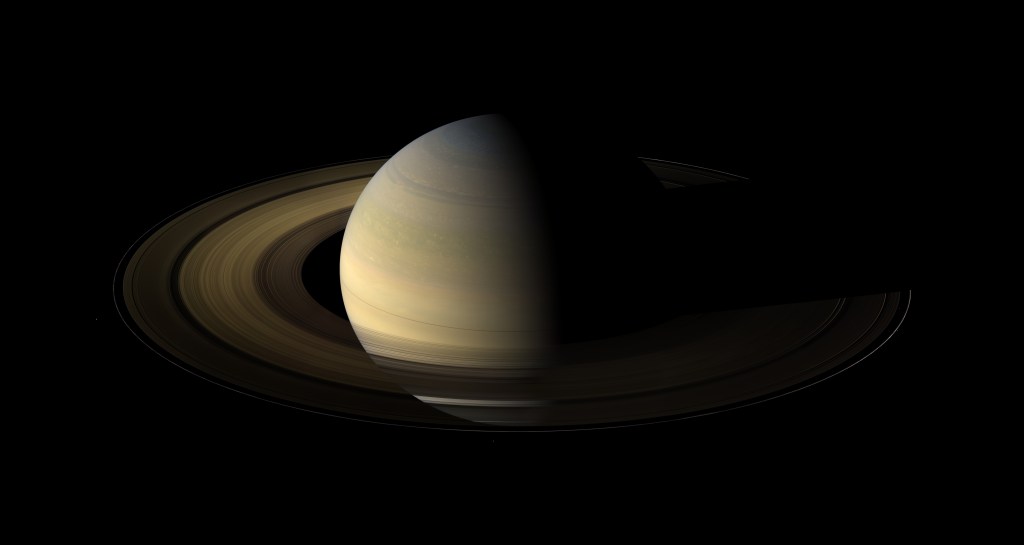
Therefore, looking at the video of the flyby of Jupiter, we can only use the distance from the terminator to the center of the cloud bands to determine a lower bound for the axial tilt. We would have to observe this distance every day of Jupiter’s almost 12 year-long year6 to find the actual tilt using this method.
Of course, for a random observation, the angle between the terminator and the pole will be closer to the average angle7, which you would expect to be half of the actual axial tilt.
Coming up next
Next time, I’ll post on why that last statement needs to be thought through more carefully.
Resources
Here are links to additional information about some of the concepts discussed:
- Axial tilt – Wikipedia
- Juno (spacecraft) – Wikipedia
- Star trail – Wikipedia
- Celestial pole – Wikipedia
- Orbital plane – Wikipedia
- Terminator (solar) – Wikipedia
- Equinox – Wikipedia
Also, visit the Astronomy Hub for more posts and other links related to astronomy.
Footnotes
- The Juno probe arrived at Jupiter in 2016 and its mission is ongoing until at least 2025. ↩︎
- It is nearly impossible to determine from this video whether the video ends over the north pole or the south pole. The north pole is determined by the right-hand rule. If you curl the fingers of your right hand in the direction of rotation, your thumb points to the north pole. The speed of the flyby and the relative motion of the probe makes it nearly impossible to determine which way the planet is rotating. ↩︎
- Mercury does not have an atmosphere. Although the atmosphere of Mars is too thin to indicate its rotation, its poles are easily determined by its ice caps. Venus and Uranus have bands that are difficult to appreciate in most images. ↩︎
- That point is called the celestial north (or south) pole. ↩︎
- This image was taken by the Cassini space probe. ↩︎
- Actually, you would be able to find the maximum angle after observing for no more than half a year. ↩︎
- This is called the expected value. ↩︎
 CoMo Science
Leave a comment