Greek and Latin Roots
Here is the list of Greek and Latin Roots for this week:
Here is a link to all of the Greek and Latin Roots we have discussed.
ACT Prep
We discussed different ways to solve a system of two linear equations on the ACT test, including:
- The “math” way:
- Solving for x and y by subtracting one equation from the other
- The “test” way:
- Using the answers to plug into the equations to see which answer works
- The “graphing” way:
- All equations, no matter how complicated, can be graphed. The place where the two graphs cross (the intersection) is the point (x,y) that solves both equations.
We also discussed identifying linear equations, which are equations that only have x and y and no higher powers and no square roots. These are all linear equations:
- y = 2x
- y = 2x + 16
- 3x = 5y – 10
- 2x + 3y = 15
All of these equations are linear and can be graphed as a straight line.
Presentations
Tips regarding presentations:
- Try to make your topic more specific
- You have the option of doing other things besides an oral presentation.
- You could do a written project
- You could even write an article for this blog
Assignments
- Fill out the list of Greek and Latin roots.
- Write in the meaning of each root
- Give at least one example of each, be prepared to give its actual definition and the way that it is related to the root word
- Example: If I gave you the root “onym”, you could give the word “synonym” which has the definition of two words with the same meaning. The two roots in the word “syn” and “onym” mean “same name”, indicating two words that name the same thing.
- Fill out the blank space at the bottom with your own root that you have discovered. This will likely come from some of the example words that you have already written. Give a different example than what you have used.
- Example: syn- means “same”, example word “synchronous”
- Be prepared to talk about where you found this information
- Look at this webpage and record the secret code which is “calcium“.
- Presentation
- Research your topic of choice and be prepared to give a 5 minute presentation on the topic, geared toward people your age level.
- Include the background information needed for someone who does not know the topic as well as you.
- Be prepared to talk about how you found this information.
Next week we will meet on Tuesday, 6/25.
Things We Discussed
Greek and Latin roots
- opt- can mean two different things:
- The Greek root means “eye” and is the root in optical, optics and optometrist
- The Latin root means “choose” and is the root of option, optional and opt
- There are many roots that have different meanings because they come from different ancient words
Circuits
Physical components of a circuit
- Breadboard
- The 5 holes in a row are all connected
- The power strip on each side are connected along the entire length of the board
- LED
- The positive end of the LED is slightly longer.
- The LED will not work when hooked up backwards
- Connecting the LED to a battery directly without a resistor will allow too much current to flow and burn out the LED
- Resistor
- We measured the resistance of a resistor
- We talked about the color codes that represent the resistance of the resistor
- Variable resistor
- We looked at how a variable resistor works inside
- Battery
- The basic battery cell produces only 1.5 V
- 6 V batteries are actually four 1.5 V batteries connected in series
- 9 V batteries are actually six 1.5 V batteries connected in series
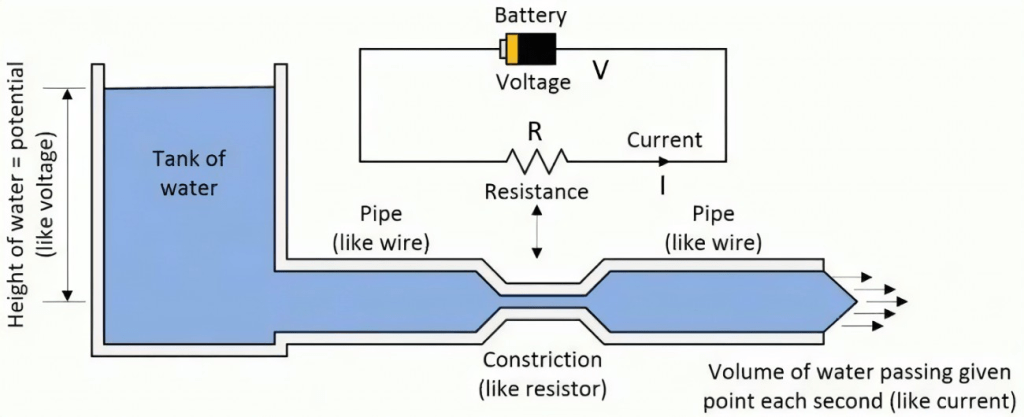
The Water Flow Model of Electricity
- Voltage is similar to the amount of pressure in a pipe caused by the height of the water. Voltage can be thought of as the amount of force pushing the electricity
- Current is similar to the amount of water flowing through the pipe.
- This is called the “hydraulic analogy“.
Voltmeter
Clarification: The device we used is actually called a multimeter because it does many things.
- Multimeter
- Voltmeter measures volts
- Ammeter measures amps
- Ohmmeter measures resistance
- DC Volts
- Volts are measured in parallel with the circuit, so volts can be measured by just connecting at two points in a working circuit.
- DC Amperes
- Amps are measured in series with the circuit, so in order to measure amps, you have to break the circuit and connect the ammeter in series with the circuit.
- Connectivity
- The connectivity sensor makes a buzzing sound when the leads are touched to two parts of the circuit that are connected
- This does not work through a large resistor
- Ohms
- The device is able to measure the resistance across a resistor, which is measured in Ohms.
Quantities vs Units
| Quantity | Unit |
| Time | second |
| Length | meter |
| Voltage | volt |
| Current | ampere (amp) |
| Resistance | Ohm |
Drawing a circuit
Starting with a working circuit, we talked about how to draw out the circuit by:
- determine what the circuit elements are
- battery
- switch
- LED
- variable resistor
- know the symbols for each element
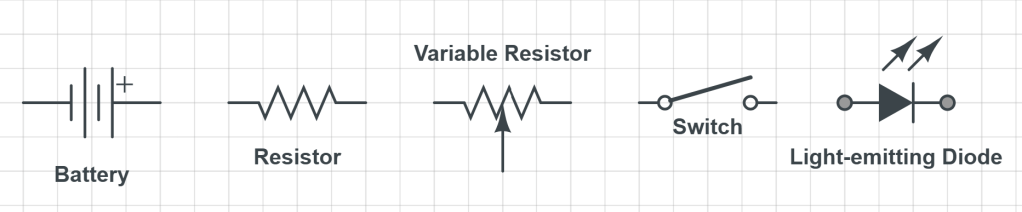
- connect these symbols together with lines for wires
- make sure the circuit makes a complete loop

Ohm’s Law
V = I×R, where:
- V represents the voltage
- I represents the current
- R represents the resistance
Series and parallel circuits
We talked about the difference between series and parallel circuits and their effects on batteries.
These batteries are in series: (The total voltage across the resistor is 18 V, the sum of the two voltages of the two batteries.)

These batteries are in parallel: (The voltage across the resistor is still 9 volts and the current is the same as if there were only one battery but because each battery supplies less electricity, the batteries last longer.)

Atomic bomb
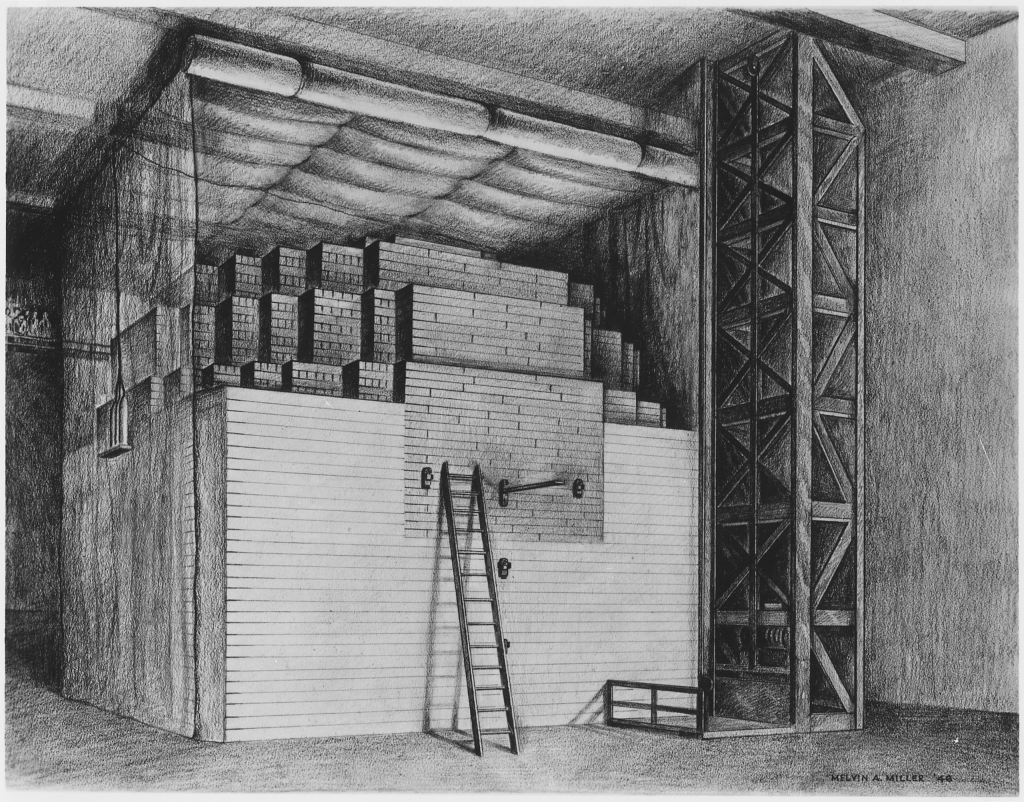
- Enrico Fermi created the first controlled fission chain reaction in a lab under a squash court at the University of Chicago. It was called “Chicago Pile-1“.
- A fission chain reaction occurs when the neutrons released by the splitting of one atom causes the splitting of more atoms.
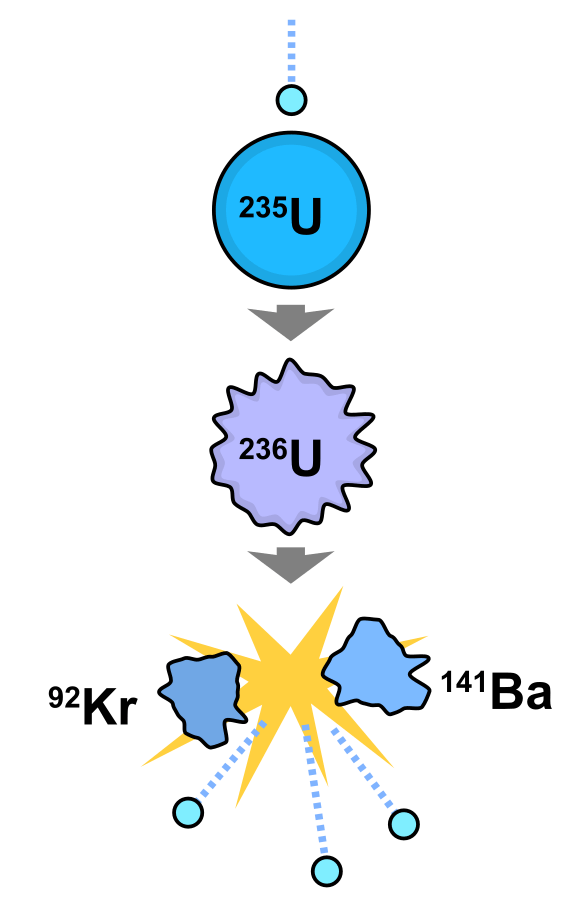
- Because each splitting releases more neutrons than were used to cause the nucleus to split, the chain reaction grows exponentially, leading to an explosion
- The chain reaction can be controlled by inserting graphite control rods to absorb some of the neutrons
- Critical mass is the amount of matter that is needed to cause a spontaneous fission chain reaction
- The atomic bomb used specific isotopes of uranium and plutonium.
- The atomic bomb used two different designs:
- “Little Boy” used uranium and a gun design
- “Fat Man” used plutonium and concentric implosion to compress the plutonium
- “Atomic bombs” use fission reactions with atoms with large nuclei that are unstable.
- “Nuclear bombs” are hydrogen bombs that use fusion reactions to fuse hydrogen into helium.

- Atomic bombs are two step bombs that use conventional explosives to put two masses of uranium or plutonium together to reach a critical mass which then sets off a spontaneous chain reaction that causes the nuclear explosion.
- Hydrogen bombs are three step bombs that use conventional explosives to set off a fission reaction which then creates enough heat to create a fusion reaction.
 CoMo Science
Leave a comment