The Roman Empire spread the Latin language throughout western Europe, leading to the development of what are known as Romance languages. Romance languages are not “romantic”; they are languages which directly developed from the Roman language, which was Latin.
The Roman Empire controlled a large part of the British island. About 29% of English words come from Latin, and another 29% come from French, which itself is derived from Latin. Yet, English is not considered a Romance language. Instead, the origin of the English language is Germanic.
The Roman-British era
The Roman empire conquered Britain in 43 AD and occupied it until 410 AD, almost 400 years. However, the Romans did not make a significant impact on the language spoken in Britain. The language spoken in Britain at the time of invasion is known as “Common Brittonic”, and it continued to be spoken after the Romans left. Common Brittonic split into regional languages that still exist, including Cumbiric, Cornish, Breton and Wesh. There are about 800 Latin words that can be found in these languages, and these words came from this time of Roman occupation.
The Anglo-Saxons
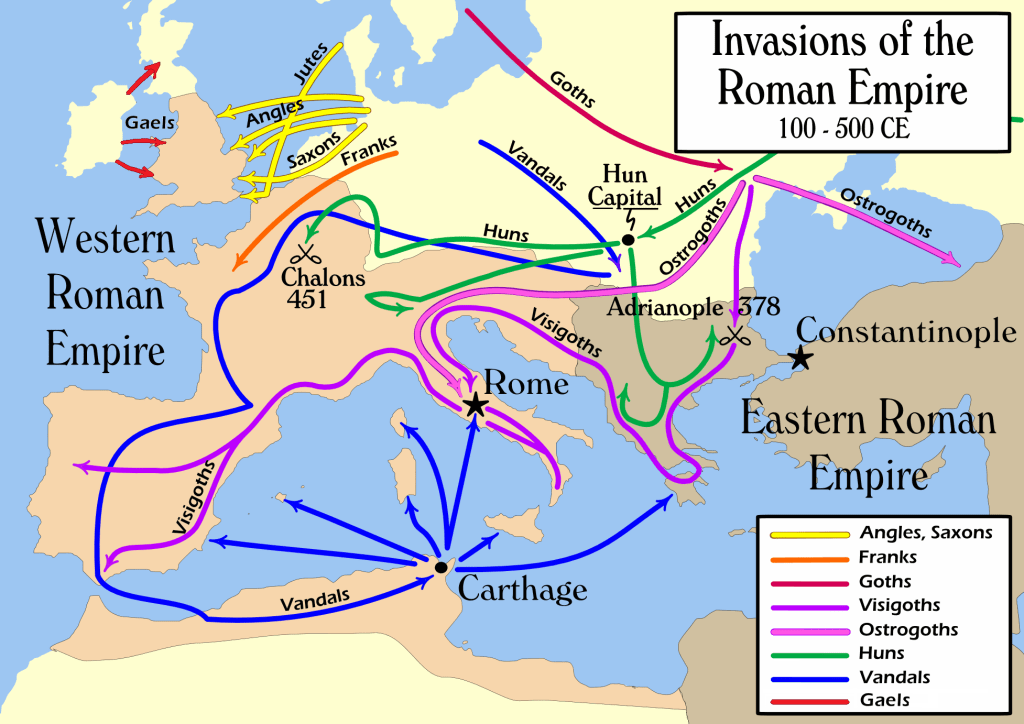
The Angles and the Saxons were Germanic tribes that settled in Britain. They controlled Britain from 450 AD to 1066 AD. The words “England” and “English” come from the name “Angles”.
The Anglo-Saxons developed a distinct culture in Britain. They spoke “Old English” which contributed the structure and many common words to modern English, although only about 26% of the words used in modern English come from Old English.
The Normans
In 1066, William of Normandy led an invasion from the European continent into Britain, replacing the Anglo-Saxon rule on the island with a government controlled by French-speakers. The common people continued to speak Old English, but they were forced to learn French to interact with the courts of law, the nobility and the government administrators. Within three hundred years, English would replace French as the official language of the government, but by then, it had been transformed into “Middle English”.
Modern English
Reflecting this history, Modern English contains words derived from multiple languages. In addition, many additional Latin and Greek words were incorporated into English during the time of the Renaissance.

Evidence of the Germanic origins
Structure
In English, the adjective comes before the noun, like in the sentence “The quick brown fox jumps over the lazy dog.” This adjective-noun order is shared with Germanic languages. Romance languages, like Spanish, which derive from Latin, have a noun-adjective order.
Small words
About 85% of Old English words are no longer in use, but those that did survive are the basic elements of modern English. Many small common English words have a Germanic origin. For example, the Latin word “piscis”, the Spanish word “pez”, the French word “poisson”, and the Italian word “pesce” all mean “fish”. But in German, fish is “Fisch”.
Similarly:
| English | German | Latin |
| house | Haus | domus |
| man | Mann | hominem |
| wagon | Wagen | plaustrum |
| milk | Milch | lac |
| God | Gott | Deus |
| rock | Rock | petram |
| book | Buch | liber |
| sun | Sonne | solis |
| fire | Feuer | ignis |
Plurals
English plural nouns that don’t end in “s” are usually of Germanic origin. Examples include:
- Children
- Oxen
- Men
- Geese
- Mice
- Sheep
 CoMo Science
Leave a comment