Upcoming Events and Goals
There is a health science research day on November 15 at the medical school. This will have a lot of students presenting their research. This is done in a room full of students standing next to posters displaying their research and answering questions about their research. There will be a wide variety of research, some of which is fairly straightforward to understand and some of which is overwhelmingly difficult. Fortunately, we are free to choose who we want to interact with. To give you an idea of the range of topics, here is a list of the posters from last year.
I would like you to consider being there from 8 to 11 am when the undergraduates will be presenting their research. You don’t have to be there the whole time. You will need to talk to your parents about getting out of school and getting there and getting picked up. I’ll be there at 8 to meet you and help you make connections, talk to people and understand their research.
In the meantime, I want to help prepare you to be able to interpret their posters so that you can understand the discussion and ask good questions.
Topics we have covered related to this:
- the organization of a research paper (which is also reflected in a poster)
- experimental design
- root words that are used frequently in research
- structural diagrams of organic molecules
- scientific notation
- error bars
- cell membrane receptors
- medical imaging
- antibodies
- microscopy pictures
- genetics
Topics we will need to cover in the next few weeks:
- polymerase chain reaction (PCR)
- model organisms
- reading graphs and charts
- bar charts
- pie charts
- line graphs
- histograms
- semi-log graphs
- log graphs
- Kaplan-Meier plots
- units
- statistics
- p values
- standard deviation
- bell curves
- confidence intervals
Greek and Latin Roots
Here is the list of Greek and Latin roots for this week:
Here is a link to all of the Greek and Latin roots we have discussed.
Test your memory of the Greek and Latin roots that we have discussed with this quiz.
This is the link to the Wikipedia list of Greek and Latin roots.
Assignments
- Fill out the list of Greek and Latin roots.
- Write in the meaning of each root
- Give at least one example of each, be prepared to give its actual definition and the way that it is related to the root word
- Example: If I gave you the root “onym”, you could give the word “synonym” which has the definition of two words with the same meaning. The two roots in the word “syn” and “onym” mean “same name”, indicating two words that name the same thing.
- Fill out the blank space at the bottom with your own root that you have discovered. This will likely come from some of the example words that you have already written. Give a different example than what you have used.
- Example: syn- means “same”, example word “synchronous”
- Presentation
- Research your topic of choice and be prepared to give a 5-minute presentation on the topic, geared toward people your age level.
- Include the background information needed for someone who does not know the topic as well as you.
- Be prepared to talk about how you found this information.
Next week we will meet on 11/7/24.
Things We Discussed
Greek and Latin roots
The following pages give the origin and meaning of various Greek and Latin roots as well as definitions of English words that are derived from these roots. Similar roots that may be confused with the root under discussion are noted. Opposite roots that are often associated with the given root are also noted. English words are generally given alphabetically, although closely related words are grouped to help with comprehension and memory. Occasionally, visual examples are also provided.
Gamma function
The factorial function, n!, is used frequently in many fields of mathematics. It is defined as n! = n(n-1)(n-2)…2·1. For example, 6! = 6·5·4·3·2·1.
A natural question arises: Can this function be extended from the set of integers to the set of real numbers?1
The answer is yes. The key is to maintain the relationship (n+1)! = (n+1)(n!). Therefore, 3.5! must equal 2.5(1.5!). When the math is worked out to maintain this relationship, you get the gamma2 function, written Γ(x). The graph of the gamma function may not be what you would expect. It looks like this:
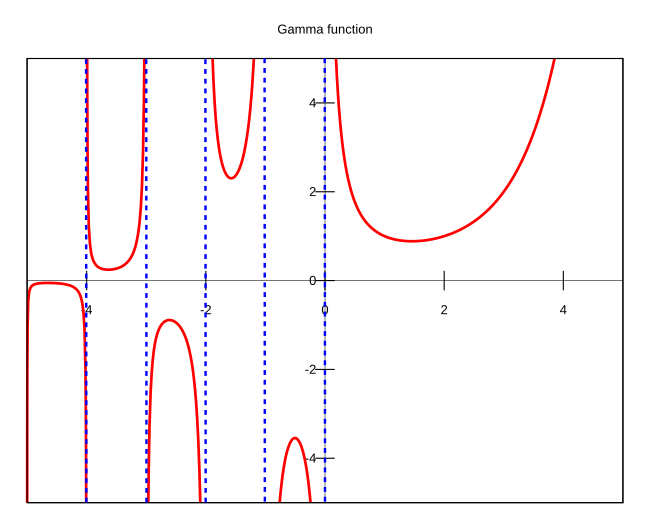
The gamma function shows up in many fields of mathematics, such as calculus.
Visual field loss
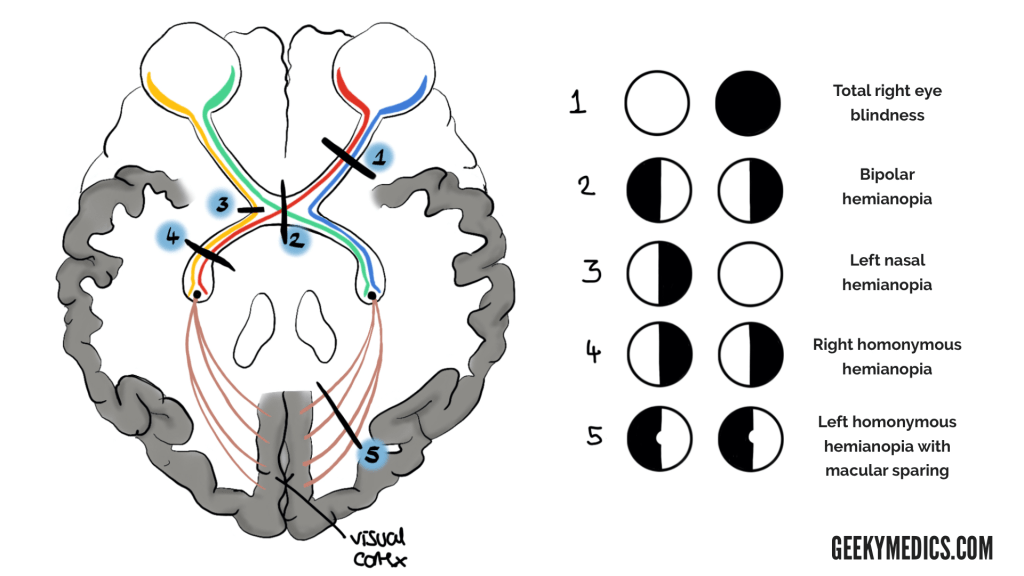
The visual cortex is part of the occipital lobe3 in the back of the brain. Nerve fibers from the eye go through the brain to the occipital lobe. The nerve fibers that carry the signal from the middle sides of the eye (red and green in the illustration above) cross4 to the other side of the brain. If an object is to the right of the person, light from the object will strike the outer side of the left eye (yellow) and the middle side of the right eye (red). Both of these will send signals to the left side of the visual cortex.
The illustration above shows how an injury to different places along the nerve fibers can result in different patterns of vision loss.
Meninges

The meninges are composed of three layers of tissue between the brain and skull.
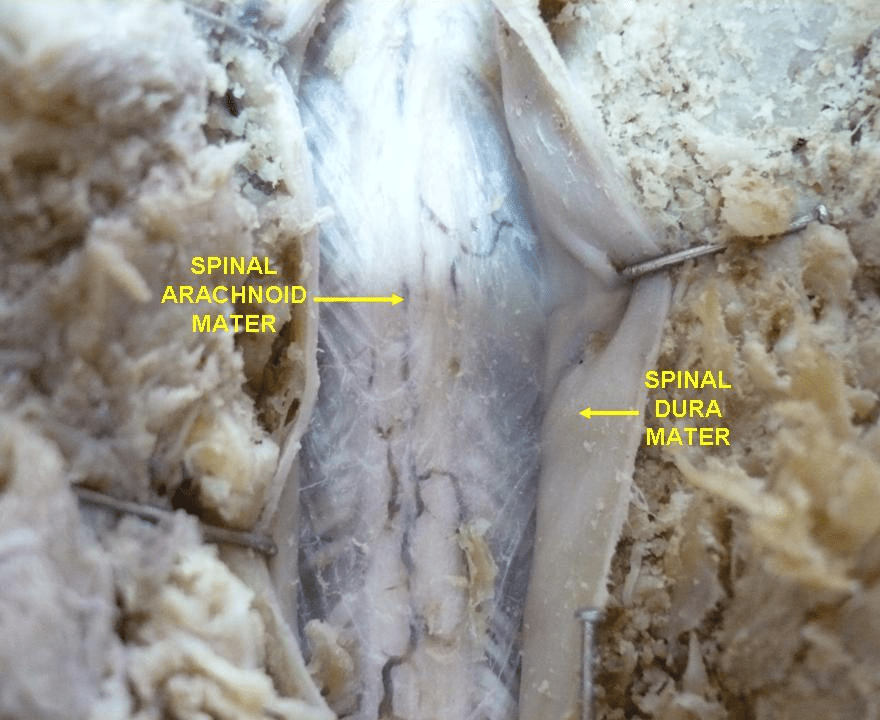
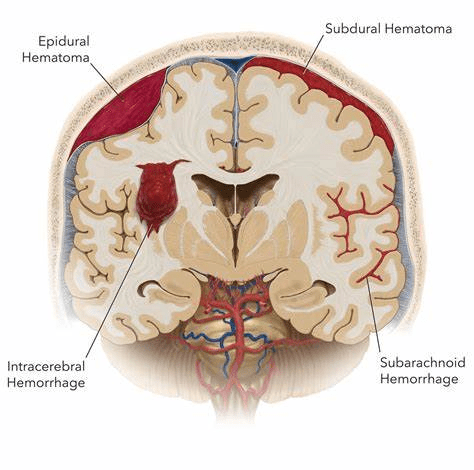
Bleeding inside the skull is often described in relationship to the meninges: epidural hemorrhage, subdural hemorrhage, subarachnoid hemorrhage.
Meningitis is inflammation that is often caused by a bacterial or viral infection. Meningitis can often cause permanent neurological problems, such as hearing loss, or even death.
Epithelium
Epithelium is one of 4 types of tissue5 in animals. Epithelium is the tissue that covers all body surfaces, including the skin and the inner and outer linings of all organs. It plays several important roles:
- it forms a boundary between the outside world and your body
- it regulates what comes into and what leaves the body
- it is most exposed to environmental damage from trauma and toxins
Cancers
Cancers that develop from epithelial cells are called carcinomas.
Sarcomas develop from connective tissue. Connective tissue is a broad term that includes bone, cartilage, muscle, fat, vascular, or other structural tissues, and sarcomas can arise in any of these types of tissues.
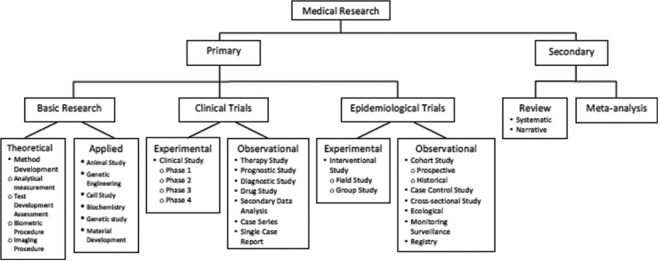
Design of research studies
We discussed several designs of research studies. These can be classified into two broad categories:
- Primary research: the authors are writing about their own research
- Secondary research: the authors are writing about someone else’s research
Secondary research can be classified into two categories:
- Systematic reviews: the authors review many studies in a systematic way and try to make sense of all of the results
- Meta-analysis: the authors combine the results of many studies to develop a better conclusion
Primary research can be classified into two categories:
- Experimental: the researchers change things
- Observational: the researchers just describe what they find without interfering
Experimental studies given better answers because the researchers have better control over the conditions. However, observational studies may ask better questions because they deal with what is happening in the real world instead of a tightly controlled situation.
The most important studies are called randomized controlled trials (RCTs) because they most closely follow the scientific method. The subjects of the experiment are divided into two groups: the experimental group and the control group. Only one variable is changed, and observations are made to see what happens.
Observational studies can be divided into two categories:
- cross-sectional studies: researchers measure some property of all large number of people at a given point in time
- longitudinal studies: researchers measure the change in some property in a group of people over a length of time
Sarcopenia

Sarcopenia is loss of muscle mass, usually age-related.
Cachexia is the loss of both muscle and fat tissue caused by inflammation, primarily due to cancer.
Anorexia is decreased calorie intake due to not wanting to eat (as opposed to not having access to food). Anorexia can be voluntary, such as anorexia nervosa, which is a medical condition. But anorexia is often caused by illness that makes a person not feel like eating anything.
Voltage, current, resistance
The three main quantities of electricity are voltage, current, and resistance.
| Quantity | Water analogy |
| Voltage | Pressure |
| Current | Water flow |
| Resistance | Diameter of pipe |
These quantities are related by the following equation: voltage = current x resistance10, often written as V=IR.
In most cases, the current is the dependent variable. Current is increased by increasing the voltage or by decreasing the resistance. This can be seen best by rewriting the equation as: I = V/R.
DC vs. AC current
| Type of current | Abbreviation | Typical source |
| Direct current | DC | battery, solar cell |
| Alternating current | AC | wall outlet |
Alternating current usually forms a sine wave:
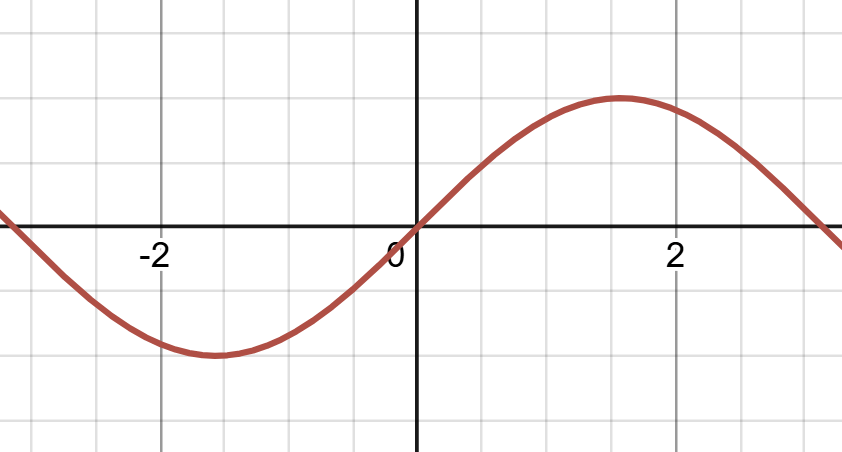
Because there is as much negative voltage as positive voltage, the average voltage in alternating current is 0. Therefore, a voltmeter must measure alternating current with a different method than it measures direct current.
Variable resistor
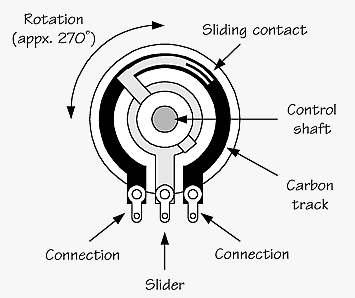
A variable resistor allows the resistance to be changed by turning a knob. Variable resistors are frequently used to adjust the volume on a radio. When the knob is turned, it lowers the resistance, allowing more current to flow and making the music louder.
Power
Power is the amount of energy per time. It is measured in watts.
Electrical power is related to other electrical quantities by this equation:
power = current x voltage (P = IV)
By combining this with Ohm’s law, V = IR, the power equation can be rewritten as:
P = V2/R
When I was using the variable power supply, I was keeping the voltage constant, but I turned down the resistance. This increased the amount of current flowing and increased the power, which overheated the resistor, causing it to smoke.
Footnotes
- This question arises with many functions that are originally defined just for integers, such as extending exponents from integers to fractions and to negative numbers. ↩︎
- Greek Alphabet ↩︎
- There are 4 lobes: the frontal, temporal, parietal and occipital lobes. ↩︎
- The place where the nerve fibers cross from one side to the other is called the optic chiasm, named after the Greek letter chi, Χ. ↩︎
- The 4 types of tissue are epithelium, connective tissue, muscle and nerve. This can be confusing because muscle can also be considered a type of connective tissue. ↩︎
- Volts are named after Alessandro Volta who first developed an early form of battery. ↩︎
- Amperes are named after André-Marie Ampère who developed the idea that an electric current produces a magnetic field. ↩︎
- Ohms are named after Georg Ohm who developed the relationship V= IR. ↩︎
- Ω is the capital Greek letter omega, equivalent to the English “O” as in Ohm. ↩︎
- This is known as Ohm’s law. ↩︎
 CoMo Science
Leave a comment