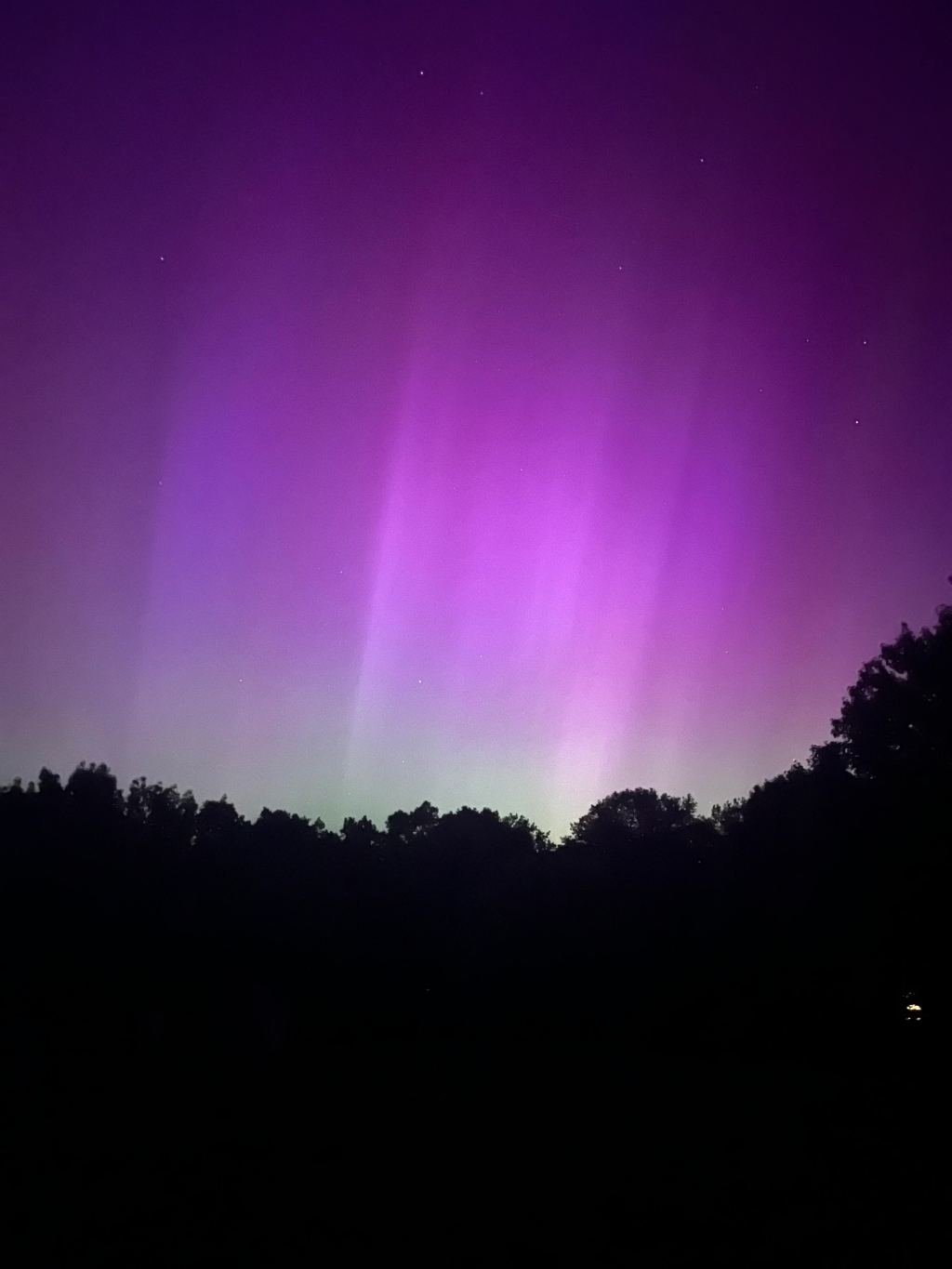
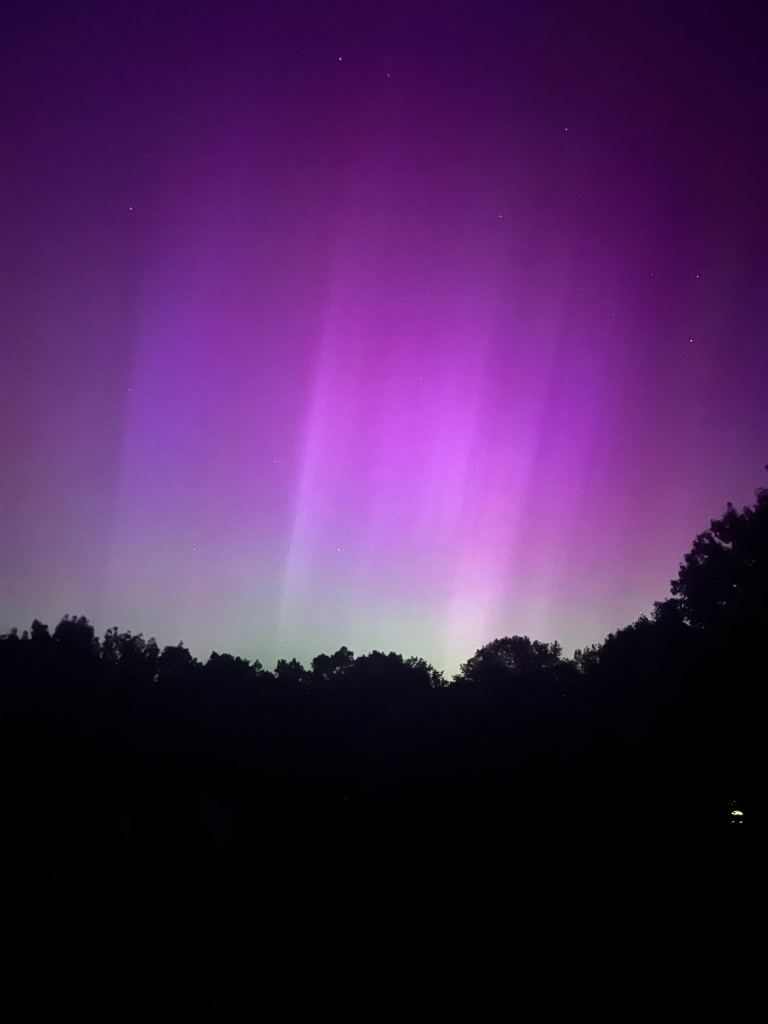
On May 10, 2024, a geomagnetic storm struck the earth and caused the northern lights to be visible as far south as Alabama.
Multiple friends posted pictures on social media and there were many reports in news articles.
I discovered that the aurora was much more visible in a phone camera than they were to the naked eye due to the camera’s 3 second exposure.
To the naked eye, the northern half of the sky was a light pink. No streaks were visible.
In photos, it is clear that there are streaks and that green is also visible lower toward the horizon.


Background
From Wikipedia:
Red: At its highest altitudes, excited atomic oxygen emits at 630 nm (red); low concentration of atoms and lower sensitivity of eyes at this wavelength make this color visible only under more intense solar activity. The low number of oxygen atoms and their gradually diminishing concentration is responsible for the faint appearance of the top parts of the “curtains”. Scarlet, crimson, and carmine are the most often-seen hues of red for the auroras.
Green: At lower altitudes, the more frequent collisions suppress the 630 nm (red) mode: rather the 557.7 nm emission (green) dominates. A fairly high concentration of atomic oxygen and higher eye sensitivity in green make green auroras the most common. The excited molecular nitrogen (atomic nitrogen being rare due to the high stability of the N2 molecule) plays a role here, as it can transfer energy by collision to an oxygen atom, which then radiates it away at the green wavelength. (Red and green can also mix together to produce pink or yellow hues.) The rapid decrease of concentration of atomic oxygen below about 100 km is responsible for the abrupt-looking end of the lower edges of the curtains. Both the 557.7 and 630.0 nm wavelengths correspond to forbidden transitions of atomic oxygen, a slow mechanism responsible for the graduality (0.7 s and 107 s respectively) of flaring and fading.
Vocabulary
Magnetic midnight of the North or South Magnetic Pole occurs when the pole is exactly between the sun and an observer on Earth’s surface. At that moment, the pole’s aurora reaches its largest extent.
Because Earth’s magnetic poles do not coincide with its geographical poles—the angle between Earth’s rotation axis and magnetic axis is about 11°—magnetic midnight differs from conventional midnight. In most of the United States, magnetic midnight occurs about an hour earlier
The K-index quantifies disturbances in the horizontal component of Earth’s magnetic field with an integer in the range 0–9 with 1 being calm and 5 or more indicating a geomagnetic storm.
Auroras are most commonly observed in the “auroral zone“, a band approximately 6° (~660 km) wide in latitude centered on 67° north and south.
 CoMo Science
Leave a comment