- Summer Camps
- Science-related Events
- Greek and Latin Roots
- Important Points We Discussed
- Details of Things We Discussed
- Things To Do
You can find a list of posts from previous science clubs here.
Summer Camps
Here is a link to STEM-related Camps in mid-Missouri this summer. It is not too early to begin planning what you will be doing this summer. Registration for many of the camps has already begun. However, some links may still be from last year because websites haven’t been updated yet.
Science-related Events
Here is a link to upcoming science-related events in mid-Missouri. I try to update this each month.
Greek and Latin Roots
Here is the list of words with Greek and Latin roots for this week:
Here is a link to all of the Greek and Latin roots we have discussed.
Test your memory of the Greek and Latin roots that we have discussed with this quiz.
This is the link to the Wikipedia list of Greek and Latin roots.
Important Points We Discussed
Electron Microscopes
- Electrons have wave-like properties just like light does.
- The ability of a wave to interact with an object depends on its wavelength. Large wavelengths do not interact with small things.
- Electrons have very short wavelengths which allow very small objects to be seen.
Details of Things We Discussed
Greek and Latin roots
halogen
- hal- means salt, gen means creating
- A halogen is an element that combines with other elements to form a salt
- The halogens are in group VII and include fluorine, chlorine and iodine
- For instance, sodium (Na) and a halogen such as chlorine (Cl) combine to make NaCl, sodium chloride, regular table salt.
- Other words include:
- halite – rock salt – natural (generally larger than table salt) crystals

- haline – salty
apocryphal
- apo- means “away”
- cryp- means “hidden” or “secret”
- An apocryphal story is a story that has questionable authenticity
- Originally, apocrypha was applied to books that were not intended for public use, only for private use. They were “hidden away”, because they were not useful for instruction and/or because their authenicity was questioned.
- The Apocrypha is a set of books that are not considered canon, but are included in some Bibles.
riparian
- rip- has the same origin as riv- as in river
- riparian means related to the banks of a river
- A riparian ecosystem is the plants and animals that live along the banks of a river
- “Arrive” comes from the idea of reaching a shore
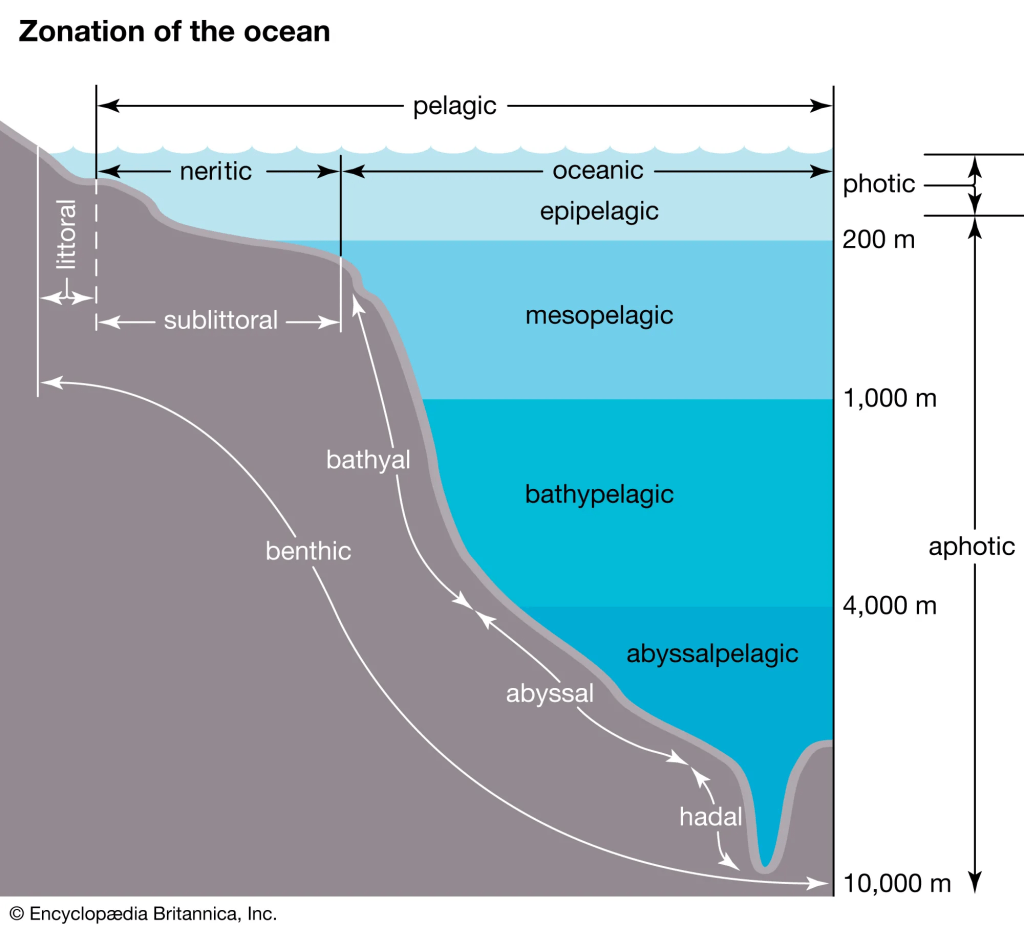
mesopelagic
- meso- means middle
- pelagic means related to the ocean
- A pelagic animal lives in the open ocean rather than along the shore (littoral zone)
Other words include:
- mesoamerica – central America
- mesopotamia – “between rivers”, in this case the Tigris and Euphrates rivers in and around Iraq

acropolis
- acro- means tip
- pol- means city
- An acropolis is a city on a hill
- The most famous, the Acropolis, is a set of ancient structures in Greece

Acromegaly – “large-tips” – a disease in which too much growth hormone causes the face and hands to enlarge. This develops in adults whose bones have fused so that they can’t grow taller. In adolescents, too much growth hormone causes gigantism.

hemorrhagic
- hem- means blood
- rrhag- means flow. (It can also mean “rupture”, but in this case, it means “flow”)
- Typically, hemorrhage implies a significant amount of blood loss. We don’t usually use the word “hemorrhage” when we are talking about blood oozing from a small wound.
amphibian
- amph – means both
- bio – means life
- All amphibians, including frogs, toads, salamanders, newts, and a relatively obscure, limbless type called caecilians, start off life in water obtaining oxygen through gills and then go through a metamorphosis to develop lungs so they can breathe air.
Other words include:
- amphibious – able to be on land and in water, often used to describe vehicles
- amphitheater – “double theater” – a round theater with seats on both sides
perennial
- per- means “through”
- enn- means “year”
- A perennial is a plant that lasts for several years, compared to an annual which only lasts one year.
- Perennial can also mean enduring for an indefinite length of time, but clearly longer than a year
Other words:
- millennium – a thousand years
anthropomorphic
- anthropo- means human
- morph- means shape or form
- anthropomorphic means having characteristics similar to humans
- C3PO is an anthropomorphic robot. R2D2 is not.
- Bugs Bunny is an anthropomorphized rabbit

spondylarthropathy
- spondyl- means “vertebra”
- arthr- means “joint”
- pathy means “disease”
- spondylarthropathy is an inflammatory joint disease of the back
Other words:
- arthritis – joint inflammation
- arthropod – having jointed legs (like an insect, spider or crab)
Electron Microscopes
Double Slit Experiment
Wave Nature of Electrons
How Electron Microscopes Work
Things To Do
- Fill out the list of Greek and Latin roots.
- Determine the roots in the example word.
- Write in the meaning of each root.
- Give at least one example of another word that shares the same root, be prepared to give its actual definition and the way that it is related to the root word.
- Presentation
- Research your topic of choice and be prepared to give a 5-minute presentation on the topic, geared toward people your age level.
- Include the background information needed for someone who does not know the topic as well as you.
- Be prepared to talk about how you found this information.
Next time we will meet on 2/20/25.
 CoMo Science
Leave a comment