General information
Microscopy is a general technique that is used in many laboratory situations. There are many specialized techniques for preparing and visualizing specimens. Many biological specimens are difficult to see without staining. However, staining often kills the specimen and therefore, specialized microscopy techniques have been developed to enable visualization without staining.
Safety
Personal Safety
Depending on the specimens you are using, there may be risk of exposure to chemicals and pathogens.
Some fixation and staining techniques also risk exposure to toxic chemicals.
There are risks of cuts from scalpel or microtome blades or from broken glass.
Safe Handling of the Equipment
The microscope is a precision piece of equipment and care must be taken in handling the microscope to prevent damage, misalignment, or contamination. Two hands should always be used to care the microscope. Special cleaning techniques should be used on the lens to avoid damaging them.
Equipment & Materials
Compound Microscope

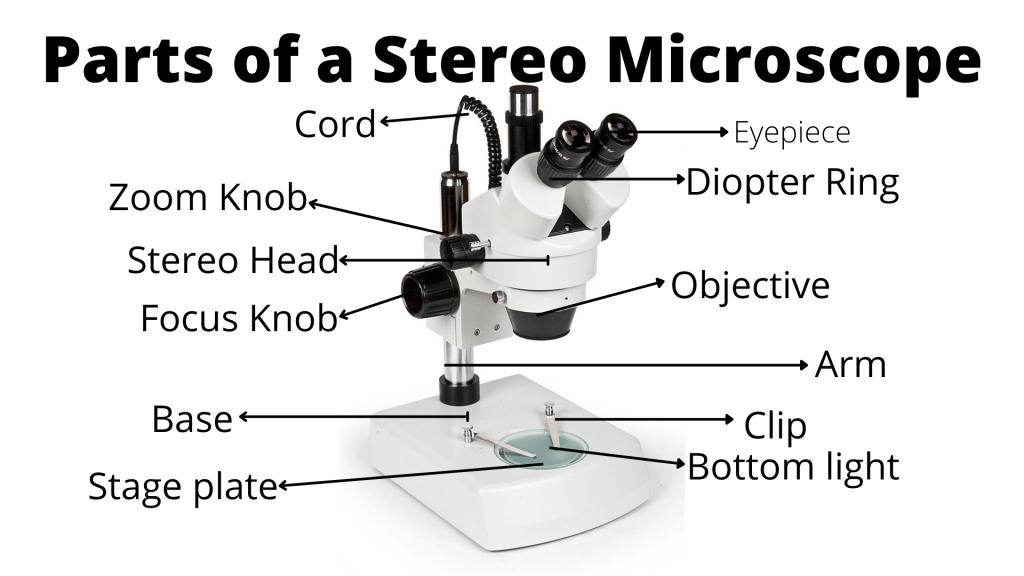
Stereo Microscope
Microscope Slides
Microscope Slides – Types, Uses and Functions and Pictures

Microscope slides are used to hold a specimen. Slides often have one side of one end that is frosted. This indicates which side of the slide is “up”. The frosted area can also be used to label the slide.

Some slides have a depression or concavity. These enable visualization of slightly larger specimens and allow movement of smaller specimens.
Cover Slips
Most of the time, a specimen is examined on a slide with a cover slip. A cover slip helps keep the specimen in place, protects the specimen from contaminating the lens, and keeps the specimen flat.
There are two main types of cover slips: rectangular or square and round.
Rectangular and square cover slips are more common and cheaper. Round ones are often used for permanent mounts, but they are more expensive.
A cover slip is sometimes called a cover glass, although some cover slips are made of plastic.

Techniques
Using a Light Microscope
Using the Condenser
Cleaning a Microscope
Slide Preparation
Wet Mount
Smears
Sections
Often tissue samples must be embedded in paraffin and then sectioned with a microtome.
Whole Mounts
Applying a Cover Slip
Using Immersion Oil
Specialized Techniques
Darkfield
Phase-contrast
More in this Series
- Lab Skills – Basic ChemistryLaboratory techniques which are first introduced in chemistry are often used throughout more specialized and advanced labs. This post reviews the equipment and techniques used, providing links to curated videos demonstrating these techniques.
- Lab Skills – Cell CultureThis post reviews the equipment and techniques used in cell culture, including links to curated videos demonstrating the techniques. Part of the Lab Skills series.
- Lab Skills – Dissection
 Dissection is a basic lab skill used to learn anatomy and also to obtain specimens for research. This post, part of the Lab Skills series, reviews basic equipment and techniques used in dissection.
 - Lab Skills – MicroscopyMicroscopy is a basic lab skill used frequently in biology, but also in geology, material science, and engineering. This post, part of the Lab Skills series, reviews basic equipment and techniques used in microscopy.
- Lab Skills – MicrobiologyMicrobiology skills are used in a wide variety of fields, including healthcare, medical research, genetic engineering, and food safety. This post, part of the Lab Skills series, reviews basic equipment and techniques used in a microbiology lab.
 CoMo Science
Leave a comment