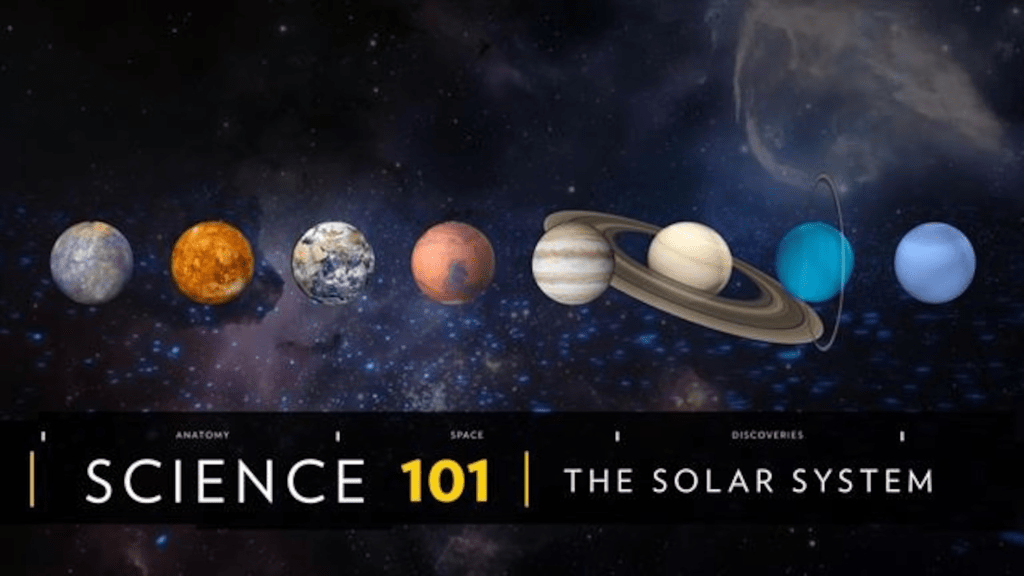
What are these called?
Planets
What characteristics make certain ones distinctive?
| Order from Left | Name | Distinctive Trait |
| 6 | Saturn | Large, easily visible rings |
| 5 | Jupiter | Easily distinguished bands |
| 4 | Mars | Red, has an ice cap |
| 3 | Earth | Clouds, oceans |
| 7 | Uranus | Bands in the atmosphere, turned sideways, thin rings |
| 8 | Neptune | Bands in the atmosphere |
| 1 | Mercury | First in order |
| 2 | Venus | Second in order |
Where would the sun be in this image?
On the left
What are the names of the planets in order starting closest to the sun?
Mercury, Venus, Earth, Mars, Jupiter, Saturn, Uranus, Neptune
Why are they round?
Planets are round because their gravity is strong enough to pull them into a round shape. Smaller objects, like asteroids, may be lumpy and not round because they do not have enough mass to pull them into a round shape.
What object was once considered a planet but is not shown in this image?
Pluto
Pluto was considered the ninth planet until other similar objects were found at about the same distance from it. Astronomers were faced with the choice of either adding many other planets or classifying them and Pluto as something else. They chose to group them as dwarf planets. There are at least 9 dwarf planets in our solar system.
Which planets in the image above are in false color?
Mercury and Venus
Venus is covered in clouds and the surface cannot be seen. This is an image of the surface of Venus using radar to penetrate the clouds. The radar is invisible, and scientists choose a color to visualize the data.
Mercury has no atmosphere so its surface can be visualized directly. However, it is mostly gray, similar to our Moon.
What major features of the solar system are missing and where would they be located in the image?
In addition to the sun, the other major missing feature is the asteroid belt which should be between Mars and Jupiter.
You could also include dwarf planets, comets, the Kuiper belt, and the Oort cloud.
What is clearly inaccurate about this image?
The scale is completely wrong. All of the planets are exactly the same size and spaced exactly the same distance apart.
There is a nebula (a large cloud of gas) in the background that has no relationship to the rest of this image other than it is also in space.
The planets would not be found in a direct line like this.
Are the tilts of the planets accurate?
They seem to be.
The image of Earth appears to show Africa and the Arabian peninsula on the left and the Arctic ice cap on the top.
Mars has an ice cap at the bottom.
Jupiter’s bands are parallel to its equator and therefore perpendicular to its axis of rotation.
Uranus is well-known for its very tilted axis.
| Planet | Tilt of Axis |
| Mercury | 0.03 |
| Venus | 2.64 |
| Earth | 23.44 |
| Mars | 25.19 |
| Jupiter | 3.13 |
| Saturn | 26.73 |
| Uranus | 82.23 |
| Neptune | 28.32 |
What are the two groups that the planets are classified in?
The terrestrial planets and the gas giants. There are 4 of each, evenly divided by the asteroid belt.
The terrestrial planets, also known as the rocky planets, are Mercury, Venus, Earth, and Mars. The gas giants are Jupiter, Saturn, Uranus and Neptune.
If you discovered a new planet, how would you determine where its equator and poles are, the tilt of its axis, and the length of its year and day?
By taking multiple images of the planet, you can (hopefully) find features on the planet that show you which way the planet is rotating. (Sometimes features are not visible on planets with thick cloud cover.)
Once you know the direction of rotation, since the sun always rises in the east, you can figure out which direction is north.
The poles are the points where the stars directly overhead do not seem to move as the planet spins.
The equator is halfway between the poles.
The tilt of the axis is defined as the angle of the line between the poles compared to the plane of the planet’s orbit.
The length of its year is how long it takes to get around the sun.
The length of its day is how long it takes to rotate around its axis.
In setting up the latitude and longitude system on the Earth, what arbitrary choice was made?
The prime meridian (0° longitude) is arbitrarily chosen to pass through the Royal Observatory in Greenwich, London, England.
 CoMo Science
Leave a comment