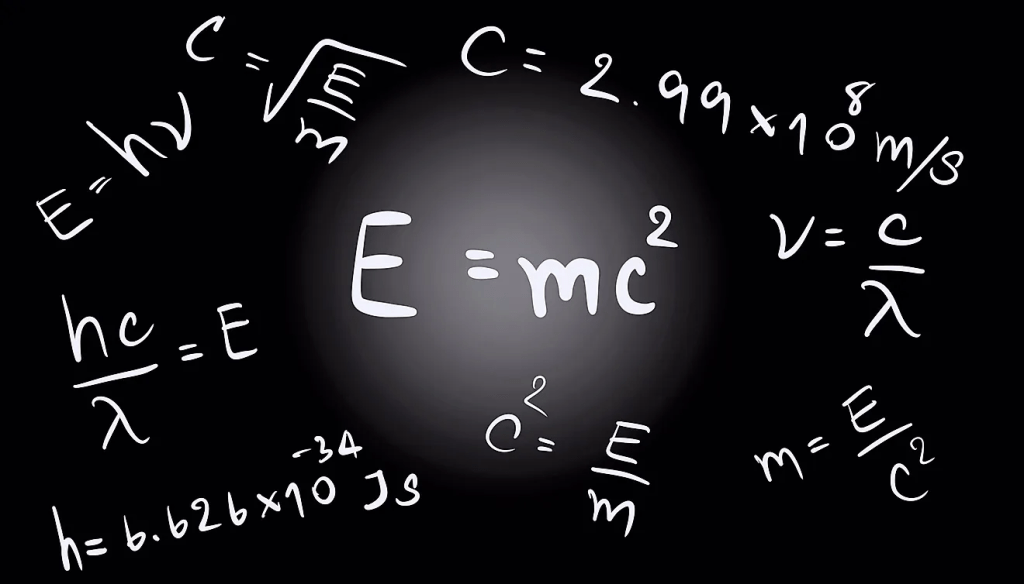
What are the physical constants shown?
There are two physical constants shown, c and h.
c represents the speed of light.
h is Planck’s constant.
How many significant digits are shown for c and h?
c has 3 significant digits. h has 4 significant digits.
What is the speed of light in English words rounded to the nearest one significant digit?
The speed of light is three hundred million meters per second.
You should understand scientific notation well enough to do this in your head.
If the reciprocal of 6.626 is 0.151, what is the reciprocal of Planck’s constant in proper scientific notation?
1.51 x 1033 J-1·s-1
You should understand scientific notation well enough to do this is in your head.
Since 1/(xy) = (1/x)(1/y), you need to take the reciprocal of 6.626 (which was given) and the reciprocal of 10-34, which is 1034. The negative exponent means the reciprocal.
This gives 0.151 x 1034. However proper scientific notation requires the first number to be greater than or equal to 1 and less than 10. Therefore, a 10 from 1034 is used to multiply by 0.151 to give 1.51, reducing the exponent from 34 to 33.
The exponent of -1 on the units indicates that the units are reciprocals of the usual units.
How many variables are shown?
Although this can look overwhelming, there are only 4 variables: E, m, λ and ν.
What are the names of the Greek letters shown?
λ is the lowercase Greek letter lambda. ν is the lowercase Greek letter nu. (This should not be confused with the Latin letter v.)
What do these variables represent?
E is energy. m is mass. λ is the wavelength. ν is the frequency.
How many physical laws are represented here and what are they?
Again, it can look like a lot, but there are only 3:
- E = mc2 -> Energy is related to mass.
- E = hν -> The energy of a photon is proportional to its frequency.
- c = λν -> The speed of a wave is equal to its wavelength times its frequency.
The other equations are just rearrangements of these three.
What are the units of the speed of light?
meters per second, which can be written as m/s or m·s-1.
What does the J stand for?
Joules, the derived SI unit for energy.
What are the units of energy in base units?
This can be determined from E = mc2. The base unit of mass is kg. The base units in c are meters per second. Therefore, the derived unit of energy is kg·m2/s2.
What are the units of Planck’s constant in base units?
The image shows that the units for Planck’s constant is Joules times seconds. Joules is a unit of energy. Therefore, since we just figured out the units of energy in base units is kg·m2/s2, then multiplying this by seconds gives the units for Planck’s constant as kg·m2/s
 CoMo Science
Leave a comment