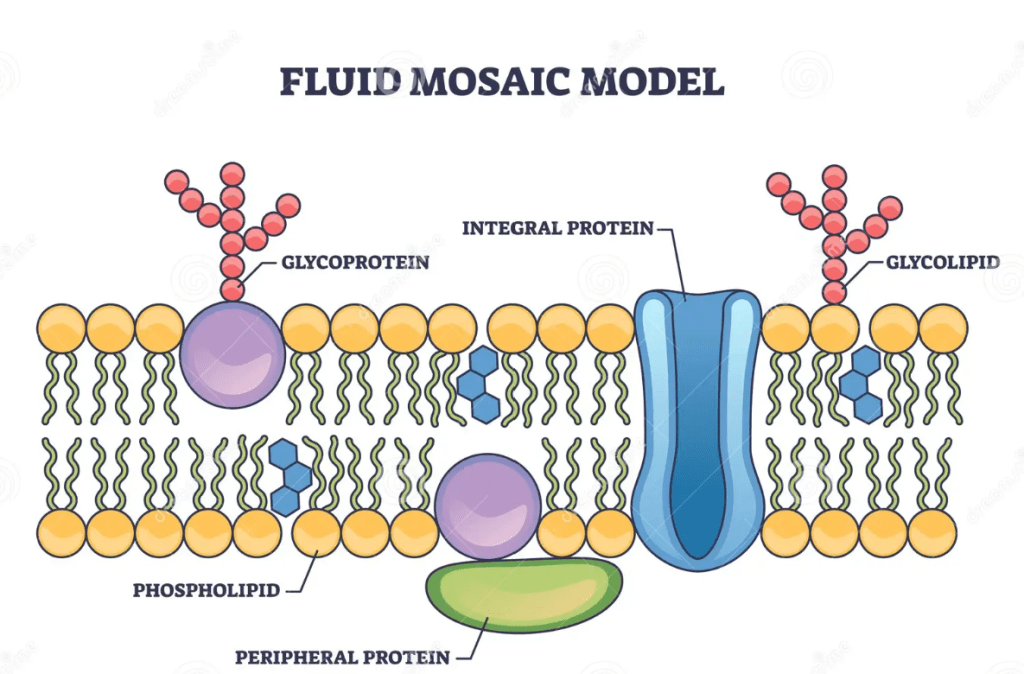
What is this image illustrating?
The structure of a cell membrane.
What are the three main macronutrients?
Proteins, lipids and carbohydrates
What do the purple circles represent?
Proteins
What does “integral” in integral protein indicate?
The protein is a permanent part of the cell membrane.
What does “peripheral” in peripheral protein indicate?
It is associated with the cell membrane but is not a permanent part of it.
Peripheral proteins often attach to other proteins on the cell membrane until a signal from outside the cell is transmitted through the cell membrane. The peripheral proteins may then detach from the cell membrane to transmit the signal into the cytoplasm.
What do the yellow circles with the two squiggles represent?
They represent the phospholipids.
What is a phospholipid?
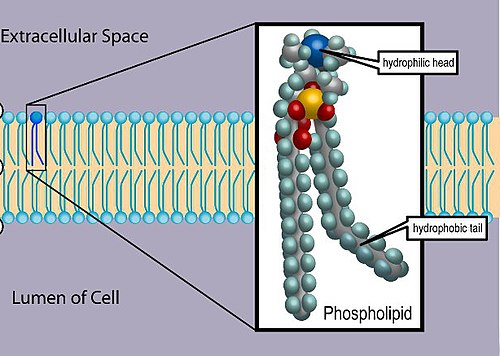
A phospholipid is a molecule with a phosphate group at one end and two lipid tails at the other end.
What does “glyco” in glycolipid and glycoprotein indicate?
Sugar or carbohydrate
This is from the same root as “gluc-” in glucose.
What are the red circles?
They are individual sugar monomers that make up the carbohydrate that is attached to the glycoprotein and glycolipid.
Unlike other biological polymers, such as DNA and proteins, carbohydrates often branch.
What do the blue hexagons represent?
Each set of 3 hexagons represents a cholesterol molecule embedded in the lipid bilayer.

Why is the integral protein shaped the way that it is?
The integral protein is drawn in cross-section, showing a pathway through the middle of the protein which is blocked at the lower end. This is a channel protein, a common type of integral protein.
Is this an animal or plant cell membrane?
Animal cell membrane
The major clue is the cholesterol. In general, animals make cholesterol and incorporate it into their cell membranes. Plants make very little cholesterol and generally do not put it in their cell membranes. Prokaryotes generally do not make cholesterol.
Which side of the membrane is external?
The top is external to the cell.
Glycoproteins and glycolipids are generally facing out of the cell surface. Peripheral proteins often help transmit a signal coming from the outside into the cytoplasm.
Why do phospholipids form a bilayer?
Phospholipids have a hydrophilic end that is attracted to water and a hydrophobic end that is repelled by water. The circle on the phospholipid represents the hydrophilic end. The squiggles represent the hydrophobic end. The hydrophobic ends are attracted to each other and therefore face the center of the bilayer.
What is the “fluid mosaic model”?
The cell membrane is made up of proteins in a bed of phospholipids, like ceramic tiles in a bed of grout in a mosaic. However, unlike grout, the phospholipids act as a fluid that allows the proteins to float around relative to each other.
 CoMo Science
Leave a comment