
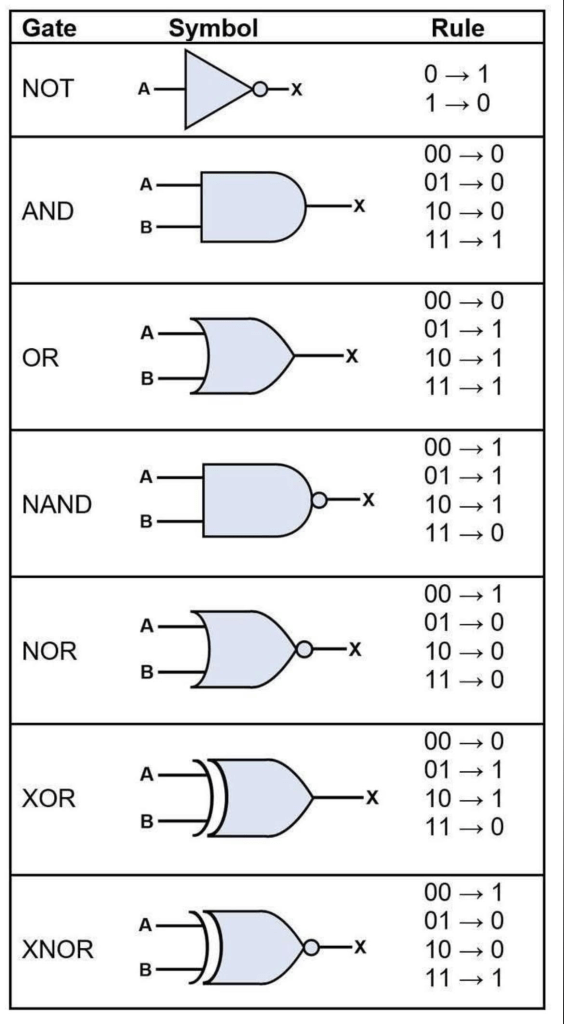
What are A & B and what is X?
A and B are the inputs. X is the output.
What does the rule 10 -> 1 mean?
The first digit is the input for A and the second digit is the input for B. The digit on the right side of the arrow is the value of the output at X.
Which of these 7 are “fundamental” from which the others are derived?
NOT, AND and OR are basic
NAND, NOR, XOR, and XNOR are derived from these.
What does NOT do?
It gives the opposite value, changing 0 to 1 and 1 to 0.
What does AND do?
It gives a 1 only if both inputs are 1.
What does OR do?
It gives a 1 if either of the inputs are 1.
How is XOR usually stated in standard English?
either one but not both
How is NAND and NOR related to AND and OR?
NAND and NOR give the opposite results of AND and OR.
What part of the symbol indicates NOT?
What other sets of rules for 2 inputs could be created? How would these rules differ from the ones shown?
The other rules would either be independent of the inputs (all zeroes or all ones) or they would treat the inputs at A and B differently (for example, 0 if A is 0 and 1 if A is 1, independent of B).
What would the symbol for a buffer gate, which has only one input ad has a rule of 0->0 and 1->1, be?
It is like the NOT gate, but without the circle.
What is this?
A diagram showing the symbols and truth tables used for various logic gates in circuit design.
Goals of this image:
- Pattern matching
- which are derived from others
- interpreting 10 -> 1
- how NAND and NOR are related to AND and OR
- NOT symbol
- buffer symbol
- Logic
- NOT
- AND
- OR
- XOR
Related Quizzes
< Previous Quiz Next Quiz >
 CoMo Science
Leave a comment